Keep the hand out of the path, not just in a glove
Most serious hand injuries happen because a body part was placed in the line of released energy, so the durable control is redesigning the task so the hand is never in that line, not a cut-resistant glove and a reminder to keep clear.
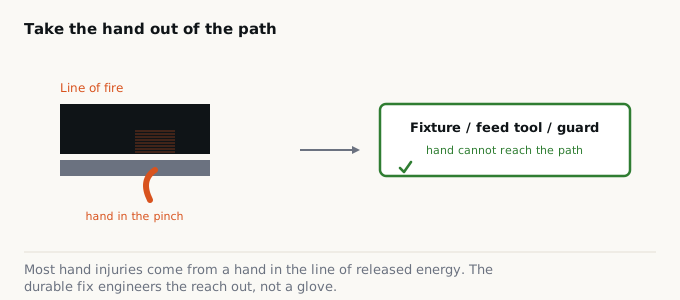
The line of fire is a place, not a mistake
Stand at a workstation long enough and the pattern shows itself. A hand reaches in to steady a part, guide a piece into a die, clear a jam, or hold stock near a blade. For most of those reaches nothing happens. The injury comes on the reach where energy arrives at the same spot the hand is occupying: a pinch point closing, a spring or hydraulic ram or a raised load releasing, a tool or workpiece that slips or swings. That spot is the line of fire, the volume of space where stored or applied energy is about to go.
Naming it that way changes the conversation. The worker did not “get careless.” The task was designed so that doing the job put a hand where the energy was headed. Fix the design and the mistake has nowhere to land.
Why hands sit near the top of the log
The exposure is structural. Hands are what we reach, guide, and hold with, so they enter the danger zone as a matter of job design, not carelessness. The injury data reflects that. In the BLS Survey of Occupational Injuries and Illnesses, contact with objects and equipment, the event family that covers struck-by and caught-in or compressed-between, is consistently among the leading event categories for days-away-from-work cases, and by body part the hand and the upper extremities are among the most frequently affected. These are not freak events. They are the routine output of tasks that require a hand in the path.
Gloves and warnings live at the bottom of the hierarchy
The reflex response to a hand injury is a better glove and a reminder to keep your hands clear. Both belong to the bottom two rungs of the NIOSH hierarchy of controls: administrative controls and personal protective equipment. NIOSH is direct about why the top rungs are stronger: “elimination, substitution, and engineering controls are more effective because they control exposures without significant human interaction.” A glove and a warning depend on the worker doing the exact right thing on every single repetition, under production pressure, for years.
A cut-resistant glove is worth wearing. It reduces the severity of a laceration. It does nothing about a press, an amputation, or a crush, and it does not keep the hand out of the pinch. Behavior and PPE are the layers you add after you have run out of ways to redesign the task, not the first answer.
Engineer the reach out of the job
The durable controls take the hand out of the path so that a mistake cannot put it back:
- A fixture, jig, clamp, or magnetic base that holds the part, so no hand steadies stock near the point of operation.
- A push stick, feed tool, or automated feeder that does the reach the fingers used to do.
- An interlocked guard or light curtain that will not let the cycle run while the opening is occupied.
- A two-hand control that keeps both hands committed away from the die during the stroke.
- Full de-energization and blocking of stored energy, mechanical, hydraulic, pneumatic, or gravitational, before any hand enters, rather than trusting a “power off” switch.
- A layout change that removes the reach-across entirely, so the path and the hand never share space.
The test of a real control is simple: with it in place, the hand physically cannot occupy the line of fire even if the person does the wrong thing.
Field check
Pull the first-aid and near-miss log and mark every finger and hand entry, then sort by workstation. Where the same operation shows up again and again, and especially where crews have developed a "knack" for reaching in past a guard or into a moving part, you have found a line-of-fire task, not a clumsy worker. Then count your controls for that task. Ask: which hand tasks still require a person to place a hand inside the swing, pinch, or release path of stored or applied energy, and could a fixture or feed device make that reach instead? Every task where the honest answer is "a glove and a reminder" is a task waiting to be engineered.