Nobody who signs the lift plan owns the ground
OSHA puts ground conditions on the controlling entity, so a lift checklist that has the crane crew tick off ground bearing capacity is collecting a signature from the one party that cannot fix, and usually cannot see, the thing most likely to drop the crane.
Every critical lift checklist in circulation looks roughly the same. Approved lift plan. Certified crane and rigging. Competent operators and riggers. Verified load weight and center of gravity. Ground bearing capacity assessment. Exclusion zone. Communication protocol. Weather monitoring.
Every item on that list is correct. Nobody sensible would remove one. But one of them is not like the others, and the difference is not what it asks for. It is who is holding the pen.
Ground conditions are not the crane crew’s to fix
Read 29 CFR 1926.1402, the ground conditions rule in OSHA’s crane standard, and notice how carefully it allocates duty.
It defines ground conditions as the ability of the ground to support the equipment, including slope, compaction, and firmness. It then says at (b) that equipment must not be assembled or used unless ground conditions are firm, drained, and graded enough that, with supporting materials if needed, the equipment manufacturer’s specifications for adequate support and degree of level are met.
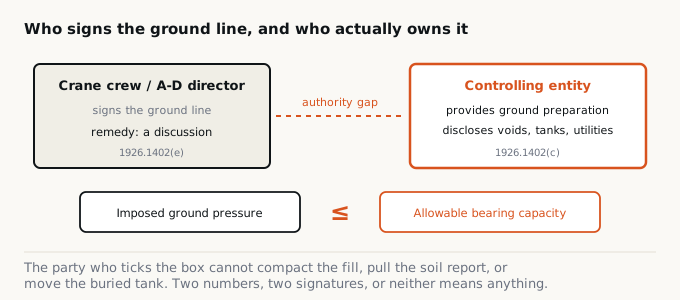
Now the part the checklist never reflects. Paragraph (c) says the controlling entity must ensure that the necessary ground preparations are provided, and must inform the user of the equipment and the operator of the location of hazards beneath the set-up area, things like voids, tanks, and utilities, where those hazards appear in documents in its possession such as site drawings, as-built drawings, and soil analyses. The controlling entity, defined in 1926.1401, is the prime contractor, general contractor, construction manager, or whoever carries overall responsibility for the project. It is not the crane crew.
And paragraph (e) tells you exactly how much power the crane crew has. If the assembly and disassembly director or the operator determines that ground conditions do not meet (b), their employer must have a discussion with the controlling entity about the ground preparations needed.
A discussion. That is the remedy the standard gives them, and it is the honest one, because it reflects reality. The A/D director can stop the job. What the A/D director cannot do is compact the fill, obtain the soil report, or relocate the buried tank under the mat. Those levers belong to someone who is not on the checklist and, very often, is not on site.
So the ground line on a typical lift plan collects an attestation from the party with the least authority over the condition and the least access to the data that would describe it. It is a signature in the wrong hands.
The number that is missing
Look again at what (b) actually measures ground against: the equipment manufacturer’s specification for adequate support. That is not an adjective. It is a pressure.
A crawler crane’s tracks and a mobile crane’s outrigger floats each impose a ground bearing pressure, calculable from the manufacturer’s data for that configuration, that load, and that boom position. The ground beneath has an allowable bearing capacity, which comes from a soil investigation, not from a boot heel. Adequate support means one number is smaller than the other, with mats or cribbing sized to close the gap.
Most lift plans I have seen carry neither number. They carry the phrase “firm and level,” which is what “firm, drained, and graded” degrades into when nobody owns the calculation. And compaction, the very first thing the standard names in its definition, is invisible from the surface. So is a void. So is a decommissioned tank. That is precisely why (c)(2) obliges the controlling entity to hand over what its drawings and soil analyses already say.
Field check
Take the last critical lift plan you signed and find the ground line. Then ask two questions of the person who signed it. Can you show me the crane's imposed ground bearing pressure for this configuration, and the allowable bearing capacity of the ground it is standing on, as two numbers from two documents? And: who is the controlling entity here, what did they hand you about voids, tanks, and utilities under the set-up area, and when? If the answer to the first is "it looked firm," you have an opinion, not an assessment. If the answer to the second is a shrug, the duty OSHA placed on someone else has quietly migrated onto your crew, and it will stay there until the crane tips.
What a lift plan that holds up looks like
It carries two signatures on the ground, not one. The controlling entity attests that ground preparations meeting (b) have been provided, and records what it disclosed about subsurface hazards. The A/D director or operator attests that the crane’s imposed pressure, in this configuration, is within the allowable capacity with the specified mats. Each party signs for the thing it actually controls, which is the only kind of signature worth having.
It carries the arithmetic, not the adjective. Imposed pressure from the manufacturer’s chart. Allowable capacity from soil data. Mat sizing that connects them.
It covers assembly, not just the lift. The ground duty runs through set-up for assembly and disassembly and through moving the crane around the site, which is exactly when a crawler is at its most vulnerable and its counterweight is in the most awkward place.
And it names a person to escalate to. Paragraph (e) gives your crew a conversation. Have the controlling entity’s name and number on the plan before the crane arrives, not after the A/D director decides the pad is soft at seven in the morning with sixty people waiting.
It is often said that cranes rarely fail without warning. That is true, and it is the most useful sentence in the whole genre. The warning is not usually a noise. It is a soil report nobody asked for, sitting in a drawer in the general contractor’s trailer, describing the fill under the pad where you are about to assemble several hundred tons of machine.
US jurisdiction. Subpart CC governs cranes and derricks in construction; other jurisdictions place the ground duty differently, and some place it nowhere at all. Confirm what binds your site, and note that a duty nobody is assigned is a duty nobody discharges.