Every exhaust hood has a design velocity. Most plants cannot produce the last measured one.
For each local exhaust hood on site, ask for two numbers: the design capture or face velocity, and the last measured value at the point where the contaminant is generated. If the only record is that the fan was running, the control is unverified.
Second shift at a structural fabrication shop. Six welding benches, each with a flanged round hood on an articulated arm. An auditor walks the line with the EHS manager, reaches up at bench four, feels air at the hood face, nods, and writes “LEV operational.” The roof fan is running. The collector has a green light. Nothing on the floor says otherwise.
Bench four’s hood sits about eighteen inches off the arc. The welder moved it there weeks ago because at nine inches it fouled his stinger hand. He did not break anything. He did not disable anything. He moved a hood. There is no gauge, no lamp and no alarm anywhere in that plant that registers what he did.
Local exhaust ventilation is the highest-value engineering control most plants already own. It is also the one they verify least, because the site check almost everywhere is the same three words: is it running.
Distance is the control
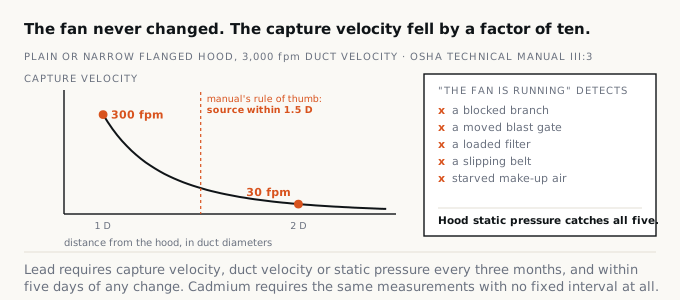
OSHA’s own Technical Manual, Section III Chapter 3 puts numbers on what happened at bench four. For a simple plain or narrow flanged hood with a duct velocity of 3,000 feet per minute, a source one duct diameter in front of the hood sees a capture velocity of roughly 300 fpm. Move that source to two duct diameters and capture velocity falls by a factor of ten, to about 30 fpm. Same fan, same duct, same motor amperage, same green light. The manual’s stated rule of thumb for simple capture hoods is that the source should sit no more than 1.5 duct diameters from the hood opening.
The same chapter notes that strong cross drafts can reduce a hood’s effectiveness by 75 percent. A pedestal fan aimed at a welder in August is a cross draft. So is a make-up air unit balanced for a different season, or a dock door that gets opened at shift change.
The fan is the least informative component in the system
The troubleshooting appendix to that chapter is a list of ways a local exhaust system fails while the fan keeps turning: a centrifugal fan wired for reverse rotation, which still runs and still sounds normal while delivering only 30 to 50 percent of rated flow; clogged ductwork, which the manual says shows up as high hood static pressure with low airflow; closed or corroded dampers; a clogged collector; a slipping belt; and lack of make-up air, which starves the whole system through negative room pressure.
None of those trip a fan. Several of them are invisible from the floor. One of them, the blast gate, is routinely moved on purpose by someone working a different branch of the same header.
The regulation asks for measurement, unevenly
Jurisdiction matters here. This is United States general industry, 29 CFR Part 1910, and the obligation is not uniform across substances.
The lead standard is explicit. Under 1910.1025, paragraph (e)(4)(i), where ventilation is used to control exposure, measurements demonstrating the effectiveness of the system, such as capture velocity, duct velocity or static pressure, shall be made at least every 3 months, and within 5 days of any change in production, process or control that might change employee exposure to lead.
The cadmium standard uses nearly the same sentence and lands somewhere else. 1910.1027 paragraph (f)(3)(i) asks for the same class of measurements “as necessary to maintain its effectiveness,” with (f)(3)(ii) adding measurement as necessary within five working days of a change that might significantly increase exposure. No fixed interval at all.
That asymmetry is where plants get lost. A team that reads only the standard covering its own substance can reasonably conclude that no number is owed, and then never builds the habit for any hood on site.
The design side is more specific than most people remember. 1910.94 sets minimum exhaust volumes for grinding, polishing and buffing hoods (220 cubic feet per minute for a wheel up to 9 inches, with a recommended minimum duct velocity of 4,500 fpm in the branch and 3,500 fpm in the main) and Table G-10 sets minimum maintained velocities into spray booths, including a design figure of 100 fpm for air-operated guns in a large booth where cross draft is under 50 fpm, with a note that cross drafts above 100 fpm should not be permitted. For abrasive blasting, 1910.94(a)(4) requires that the construction, installation, inspection and maintenance of exhaust systems conform to ANSI Z9.2-1960, incorporated by reference. Inspection is in the rule text.
Welding carries a number too. 1910.252(c)(3)(i) specifies that a freely movable hood be supplied with enough airflow to maintain 100 linear feet per minute in the zone of welding when the hood is at its most remote working distance. That number is no longer enforced as written: a 1993 OSHA letter of interpretation states the agency does not issue notices for failure to maintain those specific flow rates, and instead cites inadequate ventilation under 1910.252(c)(1)(iii) when exposures exceed limits.
Read that carefully, because it is the whole argument in miniature. The spec stopped being citable. It did not stop being true. Bench four still needs the air.
One cheap number catches most of it
Hood static pressure is a single reading taken through a tap in the duct, four to six duct diameters downstream of the hood in a straight section, per the measurement method in the Technical Manual. It responds to a blocked branch, a moved blast gate, a loaded filter, a slipping belt and a starved make-up air system. It is the reading the same manual puts on its daily inspection list, alongside blast gate positions and pressure drop across the air cleaner.
The catch is that hood static pressure is meaningless as an absolute. It is only useful against a baseline recorded when the hood was known to work, with the design flow verified. If nobody took the baseline, the first reading you take today becomes the baseline, and you are starting the clock this week rather than arguing about the last decade.
The diagnostic
Pick five fixed local exhaust hoods across different processes. For each one, ask the person who owns the system for two numbers on paper: the design capture or face velocity at the point the contaminant is actually generated, and the most recent measured value with its date. Then walk to the hood with the drawing and measure the distance from the hood face to the work. The bolded question for the room: can you show me the design velocity and the last measured velocity for this hood, and the date of that measurement? If both numbers exist and the gap is under a year, you have a verified control and a maintenance program worth funding further. If the answer is a work order log, a fan runtime record or a collector alarm history, you do not have a verification record, you have an availability record, and every hood on that list is currently unproven.
What a verified system looks like
It is not exotic. NIOSH’s published control for formaldehyde during embalming specifies the geometry and the number together: a pair of 6-foot slot hoods flanking the table, an optimum airflow of 700 cubic feet per minute, and a slot velocity of 720 fpm at a 1-inch slot width (DHHS/NIOSH 98-149). That is a control you can audit, because the document states what to measure and what it should read. NIOSH’s Engineering Controls Database collects the same kind of published specifications by process.
The consensus standards assume this too. ANSI/ASSP Z9.2 covers not only design and installation of fixed industrial LEV but also, per its own scope statement, the management, operation, maintenance and testing of those systems over their service life, with commissioning and testing as separate sections. ACGIH publishes its industrial ventilation manual in two volumes, design and operation and maintenance, which tells you something about where the failures are. I have not read the current manual’s specific test intervals and am not going to quote what sits behind a paywall.
None of this requires a capital project. It requires a tap in the duct, a manometer, a baseline and a date.
A hood that has lost its capture looks exactly like a hood that has not. That is the entire problem. The fan gives you nothing, the green light gives you nothing, and the auditor’s hand at the hood face gives you nothing. A number and a date give you the control back.