Ladder-last: the fall usually started with the wrong access
Most ladder injuries are not a training problem; they are a task that should never have been done from a ladder, so the durable fix is removing the ladder, not retraining the user.
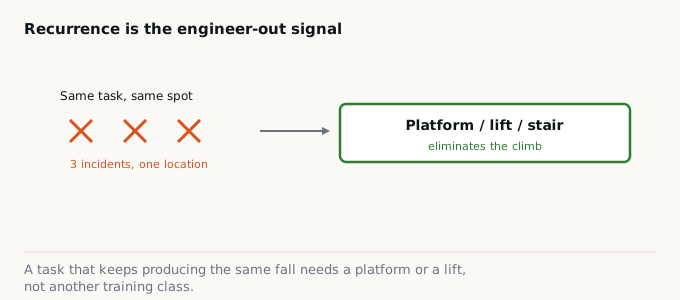
After a ladder incident, the report almost always lands in the same place: the worker was rushing, or overreached, or did not maintain three points of contact. The corrective action is more ladder-safety training. Then, months later, someone gets hurt doing the same task, on the same ladder, at the same spot. That pattern is the tell. When the same task keeps generating incidents, the problem is not the user. It is that a ladder is being used for work that should have been done from a platform, a lift, or redesigned access.
The numbers say this is not a small category. NIOSH, analyzing federal injury data for a single year, counted 113 work-related ladder-fall fatalities, an estimated 15,460 nonfatal ladder-fall injuries serious enough to cause at least one day away from work, and an estimated 34,000 treated in emergency departments. Falls remain the leading cause of death in construction, and ladders are a large share of the falls-to-a-lower-level that drive that toll.
Training sits near the bottom of the hierarchy
The hierarchy of controls, in NIOSH and OSHA guidance, ranks controls from most reliable to least. Elimination is at the top: physically removing the hazard. Engineering controls come next. Administrative controls, which include training and safe-work procedures, sit near the bottom.
Ladder-safety training is an administrative control. It teaches a person to manage a hazard that is still there every time they climb. That is why it does not durably fix a recurring task. You can train someone perfectly on a ladder and the fall exposure is unchanged; you have only asked them to be careful around it, forever, on every repetition. NIOSH is explicit that elimination is easiest and most effective when you address it at the design stage, because that is when you can change the work itself instead of retrofitting caution onto it.
Elimination here means designing out the need to climb. If the recurring task is at a fixed height, a permanent platform with guardrails removes the ladder and the fall exposure together. If it moves around, a mobile elevating work platform puts a guarded floor under the worker. If it is an access problem, a prefabricated stair replaces a fixed ladder. NIOSH’s own Prevention through Design work for construction uses exactly these examples: installing a prefabricated staircase rather than a fixed ladder, and building parapet walls tall enough that the fall hazard does not exist and fall protection is not needed. That is elimination doing the work that training cannot.
What the standard requires, and where the choice lives
OSHA’s walking-working-surfaces rules set the trigger. Under 1910.28, an employer must protect each worker on a surface with an unprotected edge four feet or more above a lower level. The ladder rules live in 1910.23. Neither standard tells you to solve every height task with a ladder; the standard sets a duty to protect against the fall, and leaves the method to you. When OSHA updated the general-industry rule, it deliberately removed the old mandate that guardrails be the primary method and gave employers flexibility to choose the control that works best in their situation.
Read that flexibility through the hierarchy and the answer is not “pick your favorite fall-protection gear.” It is: eliminate the exposure where you can, engineer it out where you cannot, and reserve the lower tiers for what is left. A ladder plus training is one of those lower-tier answers. It is legitimate for genuinely occasional, low-consequence access. It is the wrong permanent answer for a task your crew does every week.
Field check
Pull the ladder-related incidents and near-misses from the last two years and sort them by task and location, not by root cause. Which specific jobs show up more than once at the same spot? Those recurring tasks are your engineer-out list. A task that produces a second incident at the same location is not telling you the worker needs more training; it is telling you the ladder should be replaced with a platform, a lift, or redesigned access.
Find the repeaters, then design them out
The diagnostic works because recurrence is the signal elimination is waiting for. A one-time ladder use for a genuinely rare task is hard to design around and may not be worth it. A task the crew climbs for weekly, changing a filter, reading a gauge, reaching a valve, stocking a high shelf, is a standing invitation to the same fall, and it is the one worth capital.
Walk the floor and count the ladders that live in one place. A ladder that never moves is a permanent-access problem wearing a temporary-tool costume. That is usually a fixed platform or a stair waiting to be built. Then look at where crews carry portable ladders repeatedly to the same overhead work. That is usually a lift or a redesigned access point. In both cases the training was never the missing piece. The right surface was.
Compliance is not safety. You can run a fully documented ladder-safety program, retrain after every incident, and still watch the same fall happen on the same task, because training manages a hazard that engineering could have removed. Ladder-last is not anti-ladder. It is a rule of order: eliminate the climb first, and let the ladder be what is left over, not the default.