The fire starts after you put the torch down
Many hot-work fires ignite after the cutting stops, during or after the fire watch, so the post-job window is the control that prevents them, and it is the one most programs shortcut.
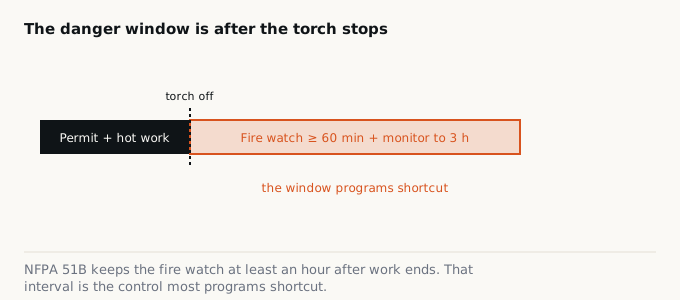
Walk any hot-work job and you will find the permit taped to a pipe, the extinguisher staged, the welder gloved up. Everyone treats the moment the torch fires as the hazard. It is not. The dangerous part of a hot-work job is the quiet stretch after the tool goes cold, when the crew wants to move on and the slag is still hot enough to find something combustible you could not see.
That is where the fires come from. A spark can travel, lodge in a wall cavity or a bin of rags, and smolder for an hour before it shows itself. By then the welder has packed up and the area looks safe. The control that catches this is the fire watch after the work stops, and it is the step programs shortcut first.
The interval, not the ignition
The written standards say this plainly if you read past the permit section. OSHA’s welding and cutting rule at 1910.252(a)(2)(iii)(B) requires a fire watch to be maintained for at least a half hour after completion of welding or cutting operations, specifically to detect and extinguish possible smoldering fires. The purpose clause matters as much as the number. The regulation is not asking someone to stand around. It is asking someone to hunt for a fire that has not appeared yet.
NFPA 51B, the consensus standard for hot work, sets a higher floor. Its 2019 edition raised the minimum post-work fire watch from 30 minutes to a full hour, and it adds a further provision: a fire monitor may be required in the hot-work area for up to an additional three hours after the fire watch ends, at the discretion of the permit authorizing individual. Read those together and the message is clear. The people who study these fires concluded that the ignition is not the event. The interval after it is.
Why closeout is the weak point
Permit issuance is easy to get right because it is a starting gun. Everyone is present, the job has energy, and the boxes get checked. Closeout is the opposite. The work is done, the crew is tired, the next job is waiting, and the person who should be watching for smoke has a radio in one hand and somewhere else to be. Nothing is on fire, so nothing feels urgent. That is exactly the condition under which a smoldering fire matures unobserved.
This is the gap between compliance and safety in one job. A program can issue a flawless permit and still burn the building down, because the permit governs the moment of least risk and the fire watch governs the moment of most. If your hot-work procedure lives mostly in the issuance step, you have documented the safe part of the job and left the dangerous part to habit.
The tell is in how the permit ends. A permit that only records who authorized the work and when it started is a permit that stops paying attention when the hazard peaks. A permit that records when the watch began, who held it, when it ended, and who confirmed the area cold is a permit that stays awake through the danger window.
Field check
Pull five closed hot-work permits from the last month and look only at the bottom half of the form. For each one, can you tell who held the fire watch, the clock time the watch started and ended, and who signed off that the area was cold before it was released? If your permit records who authorized the job but not who watched it cool and for how long, your program controls ignition and leaves the fire to chance.
What controlling the window looks like
A hot-work program that takes the interval seriously does a few unglamorous things. It sets the watch duration to match the hazard, not the minimum, and defaults up when combustibles are concealed, hidden in wall or floor openings, or reachable by conduction through metal. It makes the watch a named person with no competing task, because a watcher who is also tearing down equipment is not watching. It requires an affirmative closeout, a signed line that the area was inspected and found cold, rather than a permit that simply lapses at shift end. And it treats the extra monitoring period in NFPA 51B as a live option for high-risk work, not a footnote.
None of this is expensive. It is a matter of where you put your attention on the form and on the floor. The torch is the part everyone watches. The hour after is the part that decides whether you have a fire.