The trigger is the control, not the worker
Work-rest cycles keyed to measured WBGT thresholds outperform a toughness culture.
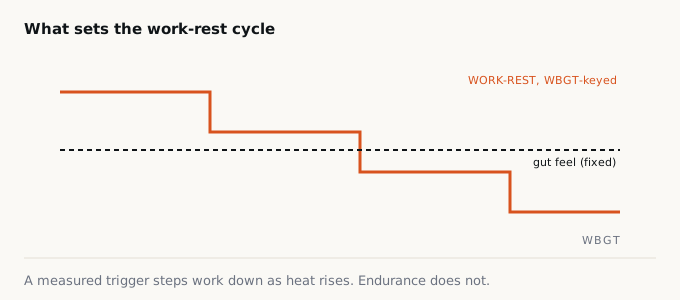
Heat is the hazard that flatters your best workers into danger. The veteran who “runs hot but never quits” is exactly the person whose core temperature climbs while he insists he’s fine. Heat illness doesn’t announce itself the way a fall does. By the time endurance fails, the physiology has been failing for a while. That’s why endurance can’t be the control. A control has to trigger before the person feels it, and the same way for the crew’s strongest member and its newest.
A number decides, not a gut feeling
Wet Bulb Globe Temperature bundles air temperature, humidity, radiant heat, and air movement into one measured value reflecting the actual thermal load, not the shade-thermometer reading that undersells a humid afternoon. The NIOSH Criteria for Occupational Exposure to Heat (Pub 2016-106) builds recommended limits on measured WBGT against workload, adjusted for clothing: as the value rises, the work-rest ratio shifts toward rest at defined thresholds. The decision is made by an instrument on a tripod, not by how the crew feels, which removes discretion at the moment discretion is worst: everyone hot, behind schedule, disinclined to stop.
Acclimatization is a schedule, not a badge
Toughness culture treats acclimatization as grit. It’s a dose curve. OSHA’s heat guidance reflects the NIOSH position that new and returning workers need a graded build-up, commonly cited as ~20% of full exposure on day one, rising no more than 20% daily. The worker most likely to go down is the unacclimatized one on a hot first day back, precisely the profile a toughness culture is blind to.
Field check
Ask your site: "At what measured WBGT does the work-rest cycle change today, and who is holding the meter?" If the answer is a fixed schedule that ignores conditions, a judgment call, or "we pull the guys if they look bad," you're running on endurance, not a control. A defensible answer is a number, a reading, and a named person.
Could your heat program protect a crew whose members aren’t tough, on the hottest day, without anyone noticing a problem first? A measured trigger passes. (NIOSH values are US recommendations, not an OSHA standard; confirm local thresholds.)