A Decade of 95 dBA: What a Flat Dosimetry Trend Actually Proves
OSHA's hierarchy of controls puts engineering fixes above earplugs for a reason: a hearing conservation program that hits 100 percent PPE compliance and still logs the same 95-plus dBA reading year after year isn't preventing hearing loss, it's documenting exposure at high resolution.
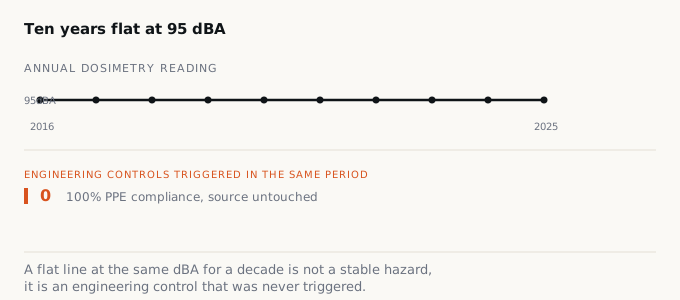
Pull the audiometric booth schedule and the noise dosimetry file for the same job classification, going back as far as the records go. On a well-run program, both exist, both are current, and both look clean. That’s the problem. Clean paperwork is exactly what a program produces whether the noise got quieter or not. The dosimeter reads what’s in the air that day. It has no opinion on whether anyone did anything about it last year, or the year before that.
What the standard actually asks for
OSHA’s Occupational Noise Exposure standard, amended in 1983 with the Hearing Conservation Amendment, requires a hearing conservation program once worker exposure hits an 8-hour time-weighted average of 85 dBA. The enforcement directive lays out the pieces: exposure monitoring, annual audiometric testing, hearing protector selection, training, and recordkeeping. Employers can meet every one of those requirements, pass every audit, and still be running a program that measures a hazard instead of shrinking it. The standard sets a floor for documentation. It does not, by itself, force the harder conversation about whether the noise itself should still be there.
That conversation is where NIOSH’s hierarchy of controls comes in, and it is blunt about the order of operations: contain or reduce the noise at the source first, then look at exposure time and worker positioning, and only then turn to personal protective equipment. NIOSH’s own guidance is explicit that “engineering controls for noise reduction should be implemented before relying solely on hearing protectors,” and that a large share of the fixes involved (maintenance, vibration isolation, enclosures, quieter equipment) are neither exotic nor, in NIOSH’s words, “always complicated or expensive.” A slower fan. A rubber-lined chute instead of a metal one dropping parts from height. Anti-vibration mounts on a pipe run. None of that requires a capital project sized like a new production line.
The file that never mentions the machine
Here’s the tell: open five years of hearing conservation files for a loud department and look for anything that references the equipment itself, not the workers. A work order for a compressor enclosure. A maintenance log showing a bearing replaced because it was running loud, not just because it failed. A note that a process was slowed down, isolated, or substituted. If those references don’t exist, the file is a PPE compliance file wearing a hearing conservation label. It’s tracking who wore what, not whether the source got quieter.
The five-year trend check
Pull the dosimetry results for your loudest job classification going back five years and lay them next to the maintenance and capital log for that same equipment over the same period. If the dBA numbers are flat and the engineering column is empty, the program has been managing paperwork, not exposure. **Has any engineering change in the last five years actually moved the dosimetry number, or has every year's answer been another box of earplugs?**
The NRR was never the real number
Even where PPE is the right tool, the compliance record can still be misleading about what protection workers are actually getting. Hearing protectors sold in the US carry a lab-tested Noise Reduction Rating, but NIOSH has documented for decades that most workers achieve far less attenuation in the field than the label suggests, noting that “most workers achieve less than half of the sound attenuation predicted by the NRR.” The gap comes from fit, not effort: comfort, insertion technique, and how consistently a plug or muff gets worn through a full shift all matter more than the number printed on the box.
For years NIOSH’s answer was a derating formula, published in its 1998 criteria document, that told employers to discount the labeled NRR before estimating real protection. That formula has since been superseded. In its 2025 science policy update, NIOSH concluded that generic derating “fail[s] to accurately predict the majority of achieved” real-world protection and now recommends individual, quantitative fit testing instead, producing a worker-specific Personal Attenuation Rating rather than a fleet-wide estimate. NIOSH’s current guidance on selecting hearing protection is equally direct that PPE “is generally less effective than elimination, substitution, and engineering controls” and should be the fallback, not the plan.
A 100 percent PPE compliance rate, in other words, can coexist with a fleet of workers getting a fraction of the protection the paperwork implies. Compliance and protection are two different measurements, and only one of them is on the audit checklist by default.
What a program that’s actually working looks like
The distinguishing feature isn’t the audiometric testing calendar or the earplug dispenser count. It’s whether the exposure number itself has a downward trend that maps to specific engineering or administrative decisions: a compressor moved and enclosed, a conveyor drop height cut, a maintenance interval tightened after vibration analysis flagged a bearing. A program built on the spine of “compliance is not safety” treats a flat dosimetry line the same way a plant treats a flat production line during a demand surge: as a signal that something upstream isn’t being touched, not as evidence of stability.
None of this argues against hearing protectors. Where source noise genuinely can’t be engineered down to a safe level, or while an engineering fix is being scoped and funded, properly fitted PPE and rigorous audiometric surveillance are exactly what the hierarchy of controls asks for at that stage. The failure mode isn’t using PPE. It’s using PPE as the terminal answer, year after year, for a noise source that was never actually evaluated for a cheaper, quieter, permanent fix. A dosimetry file that never changes isn’t proof the hazard is under control. It’s proof the file has never been asked the harder question.