A fully labeled workplace where nobody can tell you what the chemical does
HazCom compliance is measured by label presence, SDS access, and training completion. None of those measure whether a worker can state the hazard, and the standard's own word for the training it requires is effective.
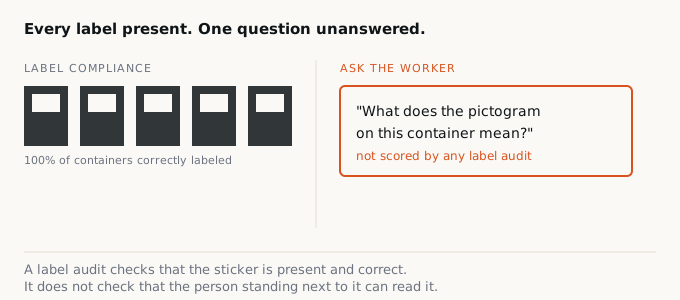
Walk a plant with a mature hazard communication program and the evidence is everywhere. Every container carries a GHS label with a pictogram and a signal word. Safety data sheets are accessible in the work area on every shift. Training completion sits at 98 percent, with signatures on file. On the documented elements, this site is compliant, and the compliance is real.
Then stop someone at a transfer point, point at the drum they are about to open, and ask a simple question: what does this do to you if it gets on your skin, and what do you do about it. The answer is often a version of “it’s a corrosive, I think,” or a gesture toward the SDS binder. That gap between a labeled workplace and an informed one is not a training-delivery problem. It is a measurement problem, and the standard is less complicit in it than most programs assume.
What the standard actually requires
In the United States, hazard communication is 29 CFR 1910.1200. The parts everyone builds their program around are the visible ones. Paragraph (f) sets the label elements for shipped containers: product identifier, signal word, hazard statement, pictogram, precautionary statement, and the name and contact details of the responsible party. Paragraph (g) requires safety data sheets in the standardized format and, critically, that they be “readily accessible” to employees in their work areas during each work shift.
Paragraph (h) is where the program is actually judged, and it is written more demandingly than it is usually implemented. It requires employers to provide employees with “effective information and training on hazardous chemicals in their work area,” at the time of initial assignment and whenever a new chemical hazard they have not been trained on is introduced. The content list in (h)(3) is specific: methods and observations used to detect the presence or release of a hazardous chemical, the physical and health hazards of the chemicals in the area, the measures employees can take to protect themselves, and an explanation of the labeling system and the safety data sheet, including how employees can obtain and use the hazard information.
Note the verb. The standard does not ask you to deliver training. It asks for training that is effective, and it asks that workers be able to obtain and use hazard information. Those are outcome words sitting inside a regulation that most programs satisfy with an input metric.
Why the visible elements drift toward theatre
Three things make the gap easy to miss.
The label is dense and read as a category, not a hazard. A GHS label carries real information, but in practice many workers decode it to a single bucket: corrosive, flammable, toxic. That bucket is enough to select gloves and often enough to work safely. It is not enough to recognise an exposure that presents late, to know that a solvent’s real risk is chronic rather than acute, or to understand that a pictogram covering serious health hazards spans effects that behave nothing alike.
SDS access is confused with SDS use. Readily accessible is a genuine requirement and worth holding. But access is measured by whether the binder or terminal exists and works. Nobody measures whether anyone has opened section 4, first aid, or section 8, exposure controls, before starting a job with that chemical. A sheet that is reachable and never consulted satisfies (g) and contributes nothing on the floor.
Completion is the only number that reports upward. Training completion is easy to count, easy to chart, and defensible in an audit. Comprehension is harder to measure, and measuring it creates a record of the people who did not understand. That is exactly the record a serious program wants and a nervous program avoids.
The version that works
The programs that hold up do something unglamorous: they test recall at the point of use, in the language the worker actually uses, and they treat a wrong answer as a finding about the program rather than about the person. They also narrow the field. A worker does not need to master 400 sheets. They need to be fluent in the ten to fifteen chemicals they personally handle, and they need to know which of those will hurt them quietly rather than immediately.
Field check
Pick three chemicals your people handle daily and ask five workers at the point of use, without letting them reach for the sheet: what does this chemical do to you, how would you know you had been exposed, and what is the first thing you do if it contacts your skin or eyes? Score only on whether the answer would keep them safe, not on terminology. Then check the two failure patterns behind any wrong answers: are the chemicals with delayed or chronic effects the ones people get wrong, and can anyone actually locate section 4 and section 8 of a safety data sheet in under a minute on their own shift. If completion sits above 90 percent and this exercise does not, your metric is measuring delivery, not understanding.
Labels and sheets are necessary. They are also the easiest part of the standard to satisfy, and the part that most resembles safety from a distance. The requirement that the training be effective is the one that costs something, and it is the one that decides whether a worker knows what is in front of them.