The HazCom Dates Are a Calendar Problem. The Reclassification Is Not.
A site can hold a current label and a current safety data sheet for every chemical it uses and still be running exposure controls that were selected against a hazard classification the 2024 rule has since replaced.
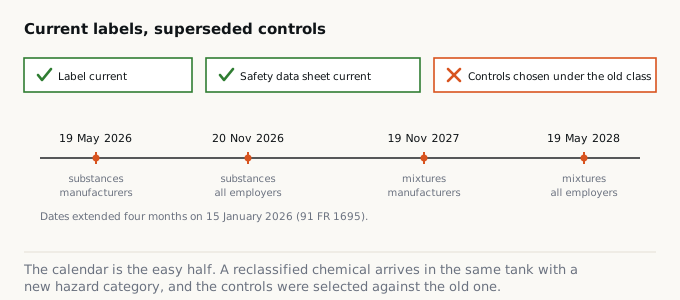
OSHA published its update to the Hazard Communication Standard, 29 CFR 1910.1200, on 20 May 2024, effective 19 July 2024, aligning the standard primarily with Revision 7 of the UN Globally Harmonized System (OSHA). On 15 January 2026 the agency extended every compliance date in paragraph (j) by four months (91 FR 1695). Most teams filed that extension as good news and moved on. This is the United States federal standard, and the extension is the least consequential thing in the rule.
The four dates, and who each one binds
Paragraph (j) now reads as follows. Manufacturers, importers and distributors evaluating substances had to comply with all modified provisions by 19 May 2026, a date already past. For those same substances, all employers must, as necessary, update any alternative workplace labelling used under (f)(6), update the hazard communication program required by (h)(1), and provide additional employee training under (h)(3) for newly identified hazards, no later than 20 November 2026. Mixtures run behind: 19 November 2027 for manufacturers, importers and distributors, and 19 May 2028 for employers (eCFR).
Until each of those dates arrives, paragraph (j)(4) permits compliance with the 2012 standard, the 2024 standard, or both. That optionality is why two chemically identical containers can reach your dock this autumn carrying different hazard categories.
State Plan states sit outside this calendar. OSHA’s general position is that State Plans have six months to adopt standards at least as effective as the federal ones (OSHA). The agency’s own HazCom question and answer document says only that State Plans with their own hazard communication standards must adopt provisions at least as effective as the final rule, and does not restate a period (OSHA). If you operate in one of the 22 State Plans covering private sector workplaces, confirm the state’s own adoption rather than assuming the federal dates.
What actually changed in the text
Appendix A revises the health hazard chapters, most visibly skin corrosion and irritation and serious eye damage and eye irritation, with non-animal test methods drawn from Revision 8 added to skin corrosion and irritation. Appendix B expands the hazard categories for flammable gases, adds a category to aerosols, and creates a new hazard class, desensitized explosives. Appendix D revises safety data sheet sections 2, 3, 9 and 11.
Paragraph (d)(1) now states that the hazard classification must include hazards associated with a chemical’s intrinsic properties, including a change in its physical form and chemical reaction products associated with known or reasonably anticipated uses. Paragraph (f)(11) keeps the six month deadline to revise labels after becoming newly aware of significant new hazard information, and adds an option for chemicals already released for shipment: do not relabel, but supply the updated label with each individual container in each shipment. Paragraph (f)(12) sets minimum label elements for containers of 100 ml or less and permits a product identifier alone at 3 ml or less where any label would interfere with normal use. Paragraph (i)(1)(iv) requires that when a concentration or concentration range is withheld as a trade secret, the safety data sheet carry one of thirteen prescribed ranges.
The reclassification is the safety problem
Read those two lists together. Expanded flammable gas categories, a new class of desensitized explosives, and a classification rule that must now account for a change in physical form mean a product you have bought for a decade can return under the same name, same code, same tank, with a category it did not previously carry.
Your area electrical classification, local exhaust selection, glove and respirator choice, storage segregation and emergency response were all chosen against the old classification. Nothing in paragraph (j) asks you to revisit them. Paragraph (h)(1) does, and it is not date driven: training is owed whenever a new chemical hazard employees have not previously been trained about is introduced into their work area. Paragraph (f)(11) runs on the same logic, six months from the moment you become newly aware, employers included. The trigger is an arriving document, not November. Availability of that document is also not the same thing as comprehension of it, which is a separate failure worth its own audit.
The reconciliation that finds it
The practical mechanism is unglamorous. Reconcile the chemical inventory against the revision dates on incoming safety data sheets, then compare section 2 hazard identification line by line against the version on file.
Monday morning check
Pull the ten highest volume chemicals on site and put the current safety data sheet next to the one that was in the binder in 2024. Then ask for every hazard class or category that changed, who reviewed the control that was selected under the old one?
The 20 November 2026 date is satisfied by updated placards, an updated written program and a training roster. A site can clear all three and still be venting, gloving and storing against a classification that no longer exists. The calendar is the easy half.