The Group Lockbox Counts Locks, Not Verifications
Adding locks to a group lockbox increases the number of locks, not the certainty that zero energy was ever confirmed. The box records attendance; someone still has to verify isolation.
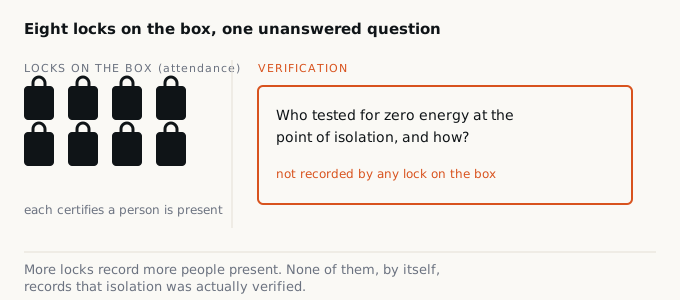
Walk up to a group lockbox at shift change and count the locks hanging off it. Twelve locks, twelve people, one key sealed inside. It looks like control. It photographs like control. It survives an audit like control. But a full lockbox answers only one question, which is how many people clipped a lock to it. It does not answer the question that keeps people alive, which is whether the energy was actually isolated and whether anyone confirmed it at the point of work.
That gap is the whole subject here. The more complex the isolation, the more moving parts, valves, breakers, and stored-energy sources, the more the lockbox drifts from a control into a ritual. And a ritual hides the one thing you most need to see.
What the standard actually asks for
In the United States, the group lockout provisions live in OSHA’s control of hazardous energy standard, 29 CFR 1910.147(f)(3). Two requirements inside it are worth reading slowly, because the ritual tends to obscure both.
First, primary responsibility is vested in a single authorized employee. That person coordinates the isolation and, per the standard, verifies that the steps taken have in fact isolated the machine or equipment from its hazardous energy sources. This is not a shared, ambient duty. It is one named human accountable for the verification of zero energy before the box goes live. OSHA’s own group lockout tutorial is explicit that this coordination sits with the primary authorized employee.
Second, each authorized employee affixes a personal lock to the group device or lockbox when they begin work and removes it when they stop. The purpose, as OSHA frames it, is that each person retains control over their own protection. A personal lock is a statement of presence and of personal exposure. It is not, and was never designed to be, a verification of isolation.
Here is the part that gets misread on the floor. A personal lock certifies that you are protected while your lock is on. It does not certify that you personally checked the machine is dead. OSHA has addressed this directly: in a 1999 interpretation on verification and a 2000 interpretation, the agency explains that individual authorized employees in a group operation may, but are not required to, independently verify isolation, because the standard vests that verification in the primary authorized employee. So the count of locks tells you the count of people relying on one person’s verification. It does not multiply the verification. It multiplies the dependency on it.
Where the ritual takes over
Now stack up the failure surface. On a shared system with several energy sources, verification is not a single glance. It is testing for zero across every isolation point, accounting for stored pneumatic, hydraulic, thermal, and gravitational energy, and confirming that a try-to-start or a gauge reading actually reflects the state at the point where hands will go.
When that work is genuinely done, the box is a good administrative wrapper around a real verification. When it is not, the box still looks identical. Twelve locks either way. The lockbox is a lossy record: it preserves the attendance and destroys the evidence of what was checked. A photograph of a full box is not evidence that anyone tested for zero energy. It is evidence that people expected someone else to have done so.
This is the compliance-is-not-safety fault line in miniature. You can be fully compliant, one primary authorized employee, personal locks all present, box sealed, and still have a verification that was rushed, delegated by assumption, or performed against a stale isolation list from before the last piping change. The paperwork cannot tell the difference. Only the verification can, and the verification is exactly the thing the box does not store.
Field test
Stop at your next group lockbox and ask the crew a single question, then watch whether the answer is a name or a shrug: who tested for zero energy at each isolation point, and can that person tell you what reading confirmed it? If the honest answer is "the box is full" or "the permit is signed," you have counted locks, not verifications, and the difference is where people get hurt.
What actually works
Three moves separate a control from a ritual, and none of them require more locks.
Name the verifier, out loud, every time. The standard already demands a primary authorized employee. Make that person say their name and the isolation points they confirmed, and log it at the box, not on a form filed elsewhere. Accountability that cannot be located is accountability that was never assigned.
Verify against the machine as it is, not as it was drawn. Isolation lists rot. A line gets re-piped, a temporary bypass is added, a second feed is installed, and the procedure still lists the old points. Verification has to reconcile the list against the equipment in front of you, or it is verifying a memory.
Preserve the check, not just the attendance. If the only artifact your group lockout leaves behind is a count of locks, you have optimized for the audit and starved the investigation you will run if something goes wrong. Record what was tested and what reading confirmed zero. That record is cheap to make and expensive to lack.
Locks on a box are easy to add and easy to count, which is exactly why they crowd out the harder thing. The harder thing is one person, named and accountable, confirming that a complex system is dead at every point where a hand will go, and leaving behind proof that they did. Everything else on that box is decoration.