Your calibration log proves the meter works, not the worker
A bump-test or calibration record verifies device integrity; it says nothing about whether the monitor was worn, powered, in the breathing zone, and heeded.
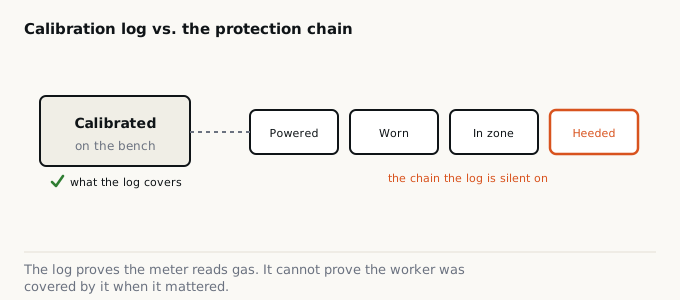
A calibration log is one of the tidiest documents in the EHS binder. Rows of dates, gas concentrations, pass marks, an initial. It looks like proof of protection. It is not. It is proof that a piece of hardware responded to a known gas on a bench. Whether that instrument then did any protecting depends on a chain of events the log never touches: was it powered on, worn on the worker’s body, positioned in the breathing zone, and did the worker react when it alarmed.
Confusing the two is a category error, and it is common enough to be worth naming.
Bump test and full calibration are not the same check
OSHA’s guidance on calibrating and testing direct-reading monitors draws the line clearly. A bump test, also called a function check, is a qualitative check: a challenge gas is passed over the sensors at a concentration and for long enough to trip every alarm. Its only job is to confirm that gas can reach the sensors and that the alarms fire. A bump test does not provide a measure of the instrument’s accuracy.
A calibration check compares the reading against a known test-gas concentration and confirms the response falls within the manufacturer’s tolerance, typically plus or minus 10 to 20 percent. A full calibration goes further and adjusts the instrument’s reference point to match a certified, traceable gas. A bump test or calibration check should be done before each day’s use, and if the instrument fails, it gets a full calibration; if it fails that, it comes out of service.
So the log answers a real question: does this device still measure gas correctly. That question matters. It just is not the question that keeps a worker alive.
The log is a device-integrity record, not an exposure control
An exposure control is something that stands between the hazard and the worker’s lungs: ventilation, a covered drum, an evacuated space, a monitor actually worn and heeded. A calibration record is a maintenance artifact. It lives back at the gas dock, not at the point of exposure.
Consider everything the log is silent on. It does not record that the instrument left the shelf. It does not record that it was turned on and allowed to warm up and zero in air similar to the work conditions. It does not record where it sat on the worker. Breathing-zone sampling exists because concentration varies with distance from the nose and mouth; a monitor clipped at the ankle or left in a gang box reads a different atmosphere than the one being inhaled. And the log certainly does not record the human step at the end: that the worker recognized the alarm and got out.
For confined space work the gap is sharper still. OSHA’s 1910.146 requires pre-entry atmospheric testing, and its non-mandatory Appendix B directs that the atmosphere be tested with a calibrated direct-reading instrument for oxygen first, then flammable gases and vapors, then toxic contaminants, in that order. Oxygen comes first because most combustible-gas sensors are oxygen-dependent and read unreliably in an oxygen-deficient atmosphere. A perfect calibration log tells you nothing about whether the tester followed that sequence, tested at the right depths, or tested at all before someone went in.
The gas-dock-to-breathing-zone audit
Pull ten recent calibration records, then go find the ten events where those instruments were used: a confined space entry, a hot work permit, a tank cleaning. For each one, ask: can I prove this monitor was powered on, worn in the breathing zone, and that someone acted on the alarm, using a record other than the calibration log? If every answer traces back to the same log, you are auditing the instrument, not the exposure. Look for the independent evidence: entry permits noting pre-entry readings in the correct order, peak and alarm data downloaded from the instrument's datalog, and a documented response when an alarm fired.
What actually closes the gap
Three practices convert a calibration program into an exposure program. First, use the datalogging most modern instruments already have. Peak readings, alarm events, and time-on give you the record the calibration log cannot: what the atmosphere was and whether the device was live in it. Second, tie the instrument to the permit. A confined space or hot work permit that captures the pre-entry readings, in oxygen-combustible-toxic order, links the device to a specific exposure and a specific decision to proceed. Third, audit alarm response, not just alarm function. A bump test proves the horn works. Only a drill, a near-miss review, or datalog evidence proves the worker moved when it sounded.
None of this replaces calibration. A drifted sensor is a real failure mode, and daily verification is sound practice. The point is narrower and harder to dodge: a clean calibration binder is necessary and nowhere near sufficient. When an investigator asks how you knew the worker was protected, “we calibrated the meter” is an answer about the meter. Have the other answer ready.