Separate people from trucks by design, not by hope
If pedestrians and powered industrial trucks share the same floor and the only thing keeping them apart is attention, the control has already failed.
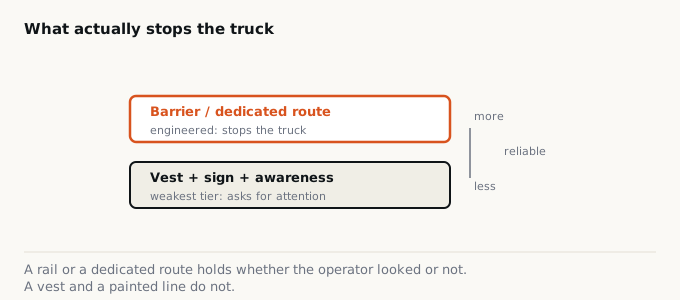
Walk any busy dock, and you will see the same setup: a forklift aisle, a painted line, a sign that says “watch for trucks,” and a crew in hi-vis vests moving through it. Everyone means well. Nobody is careless. And this is exactly the arrangement that keeps producing struck-by injuries, because it asks a person and a several-ton truck to avoid each other using nothing but awareness.
NIOSH has been blunt about the scale of this for years. In its alert on forklift-related deaths, it estimated that nearly 100 workers are killed and another 20,000 are seriously injured in forklift incidents each year. When NIOSH broke down the fatalities by type, workers on foot struck by a forklift accounted for roughly one in five deaths. These are not exotic events. They happen at intersections, at blind corners, and in aisles that people and trucks were never actually separated from each other in.
Awareness is the weakest control we have
The hierarchy of controls, published in NIOSH and OSHA guidance, ranks how we reduce a hazard from most reliable to least. Elimination and substitution sit at the top. Engineering controls, physical changes that isolate people from the hazard, come next. Administrative controls, the rules and training and signage, sit near the bottom. Personal protective equipment sits at the very bottom.
A hi-vis vest is PPE. “Be aware” signage and annual awareness training are administrative. Both are real and both have a place, but they are the two least effective tiers in the framework, and we routinely lean on them as if they were the whole plan. A vest does not stop a truck. A sign does not stop a truck. Awareness fails the moment a person is tired, distracted, new, or simply looking the wrong way for two seconds, which is all it takes.
Engineered separation does not depend on any of that. A guardrail between a workstation and an aisle holds whether the operator saw the worker or not. A dedicated walkway routes people where trucks do not go. A one-way route removes the head-on conflict entirely. An exclusion zone keeps trucks out of the space where people cluster. None of these require anyone to notice anything in the moment. That is the point.
What OSHA and NIOSH actually say to do
OSHA’s operating rules for powered industrial trucks under 1910.178 are mostly behavioral: the operator must slow down and sound the horn where vision is obstructed, keep a clear view of the travel path, and travel at a speed that allows a safe stop. Those are administrative controls layered onto the truck. They matter, but they are not separation.
The separation language shows up elsewhere. OSHA 1910.176(a) requires that permanent aisles where mechanical handling equipment is used be kept clear and appropriately marked. And NIOSH, in that same forklift alert, goes further than paint. Its recommendations to employers are worth reading as a ranked list: separate forklift traffic from other workers where possible; limit some aisles to workers on foot only or forklifts only; and install physical barriers where practical to isolate workstations from aisles traveled by forklifts. NIOSH lists floor striping as the fallback for when barriers cannot be used, not the first move.
That ordering is the whole argument. Barriers first. Dedicated routes next. Paint when nothing else fits. If your site has inverted that order, you have chosen the weakest available control and called it a traffic plan.
Field check
Walk your busiest truck-and-pedestrian intersection at shift change, when foot traffic peaks. Then ask: if every operator looked away at the same instant, what physically stops a truck from reaching a person here? If the honest answer is a painted line, a sign, or the vest itself, you are separating by hope. If the answer is a rail, a wall, a dedicated walkway, or a route trucks are not allowed to enter, you are separating by design.
The upgrade path is concrete
You do not have to rebuild the plant. You have to reclassify what you already call controls. Where a workstation opens onto a truck aisle, a guardrail turns an administrative “stay alert” into an engineered barrier. Where people cross a truck lane to reach a break room, a dedicated walkway or a gated crossing removes the crossing conflict. Where two-way truck travel meets a blind corner, a one-way route plus a physical barrier does more than a convex mirror and a horn ever will, because it removes the conflict instead of asking two people to manage it.
NIOSH also flags the human-flow spots we forget: restrict trucks near time clocks, break rooms, and main exits, especially at shift change and breaks, when foot traffic is heaviest. Those are the moments awareness is thinnest and the moments separation matters most.
Compliance is not safety. You can be fully trained, fully signed, fully vested, and fully compliant, and still have a floor where the only thing between a person and a truck is a good day. The control that actually reduces struck-by injuries is the one that keeps working on a bad one.