An exoskeleton moves the load, the question is where
Occupational exos don't erase strain, they redistribute it. Measure the transfer, not comfort.
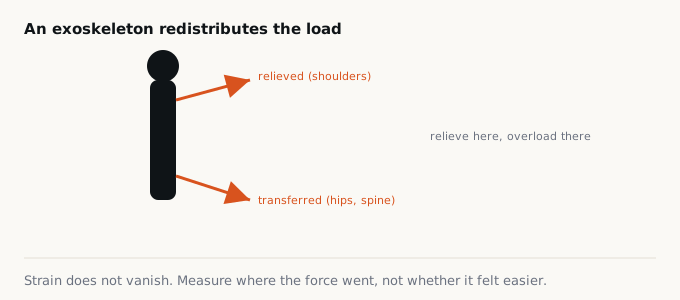
The pitch for occupational exoskeletons is intuitive: strap on assistance, and the strain of lifting or overhead work goes away. But strain doesn’t vanish, physics won’t allow it. A passive device that unloads the shoulders is routing that force somewhere; one that supports the low back during a lift redirects force into the body at a new point of contact. The question was never “does it feel easier.” It’s “easier where, and harder where else.”
Relief is not elimination
NIOSH has been explicit: some devices may transfer load between musculoskeletal regions in ways that still put workers at risk, a hip-supported device can pull load off the arms while increasing load carried by the spine and lower extremities. That’s the hazard hiding inside a comfortable product: relieve the region you were measuring, quietly overload one you weren’t. NIOSH’s earlier review of wearable load-reducing devices makes the same caution, benefit at one joint must be weighed against cost at another. This is why comfort surveys are the wrong evidence: workers can prefer a device that reduces perceived shoulder effort while raising compressive load on the lumbar spine, the very load ISO 11228-1 on lifting and carrying exists to bound. Preference tracks felt exertion, not tissue loading; injury follows the second.
The hazards the business case does not list
Load transfer is the argument people have. There is a second set of considerations that rarely reaches the evaluation at all, because none of them show up in a fitting session on a quiet afternoon.
A worn device changes the body’s outline. That matters wherever there is rotating equipment, a conveyor, a pinch point, or a confined-space opening sized for a person and not a person plus a frame. Anything that adds profile or protruding structure deserves a snag and egress assessment in the specific places it will be worn, not a generic one.
It also changes movement. Gait, balance, reach envelope and recovery from a stumble are all altered by a device designed to resist certain motions, which is worth thinking about carefully before it goes on a ladder or scaffold.
And it adds thermal burden. A harness with padding across the torso is insulation, worn by someone doing physical work, sometimes outdoors. On a site already managing heat exposure, that is a real interaction rather than a footnote.
None of these rule the devices out. They mean the assessment has to happen where the work happens, in the season the work happens, rather than in a conference room.
Fit is a fleet problem, not a device problem
Most evaluations test a device. Deployments buy a fleet, and that is a different question.
An exoskeleton transfers load through specific contact points, which means its behaviour depends on those points landing where the design assumed. A device fitted to one worker’s proportions does something measurably different on someone taller, shorter, or differently built, and the difference is not just comfort. It changes where the force goes, which is the entire safety argument.
That creates two practical problems people discover late. Sizing across a real workforce, where a single size will not span the range and multiple sizes multiply the cost the business case was built on. And sharing, because a device passed between shifts is a device being refitted twice a day by people under time pressure, which is exactly when adjustment gets skipped.
Ask any vendor for the anthropometric range their transfer data covers, and compare it against your actual crew rather than an average one.
The test
Before crediting an exoskeleton with reducing MSD risk, ask: has anyone measured the load it adds to the regions it transfers force into, and does the net biomechanical picture improve, not just the assisted joint? If your evidence is a satisfaction score or a single-joint measurement, you haven't tested the actual question.
Check which tier you are buying
There’s a real place for these devices, for sustained overhead or repetitive lifting, a well-matched exo may genuinely lower a specific exposure. But treat it like any engineering control: characterise the hazard, apply the device, re-measure the whole body against a manual-handling reference. A control that just relocates the risk hasn’t reduced anything.
One question settles whether the purchase is sound, and it is not about the device at all. Ask what the alternative on the table was. If the exoskeleton is being bought because raising the work surface, adding a lift assist, or changing the part presentation was assessed and genuinely will not work, it is doing an honest job at the tier available.
If it is being bought because redesigning the workstation was harder to fund, then a worn, worker-dependent control has been chosen over an engineering one, and the hierarchy has been inverted in the usual direction. The device may still help. But the reason it is on the shopping list is the thing worth examining first.