The Two Feet Nobody Tapes Off
OSHA's spoil pile setback is one of the only bright-line, tape-measure numbers in excavation safety, and on active sites it gets ignored more often than it gets enforced, both as a falling-material hazard and as an unaccounted-for load on the wall the protective system was sized for.
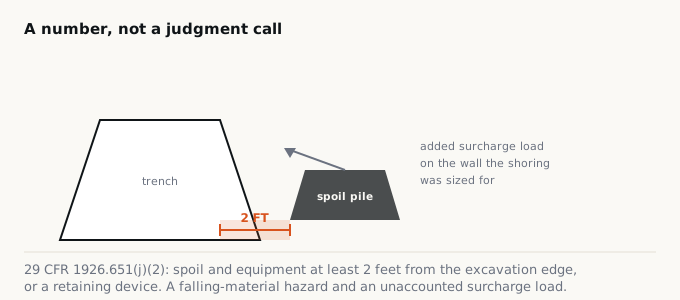
The excavator operator swings a full bucket, drops it, swings back, drops another. The boom does not reach far, and repositioning the machine every few cycles costs time nobody is paying for. By midmorning the spoil pile has grown into a ridge running the length of the trench, its toe sitting a foot, sometimes less, from the lip. Nobody measured it. Nobody was going to.
That gap, or the absence of one, is governed by a rule that is unusual in excavation safety: it is not a judgment call. It is a number.
A rule that does not need a competent person’s opinion
Most of Subpart P asks for interpretation. Soil classification under 29 CFR 1926.652 and its appendices requires a competent person to run visual and manual tests and assign a soil type, a judgment that can shift with rain, vibration, or a utility trench cut the week before. Sloping and shoring design depends on that classification. All of it takes training and defensible reasoning, and reasonable people inspecting the same wall can land in different places.
The spoil pile rule has none of that ambiguity. 29 CFR 1926.651(j)(2) states it directly:
“Employees shall be protected from excavated or other materials or equipment that could pose a hazard by falling or rolling into excavations. Protection shall be provided by placing and keeping such materials or equipment at least 2 feet (.61 m) from the edge of excavations, or by the use of retaining devices that are sufficient to prevent materials or equipment from falling or rolling into excavations, or by a combination of both if necessary.”
Two feet, or a retaining device. That is a tape measure and a yes or no answer, not a soil-classification worksheet. It is one of the cheapest, most easily verified controls in the entire standard, and on a working site it is routinely the one nobody bothers to check, because the excavator’s swing radius, not the regulation, decides where the spoil lands.
Two hazards, not one
The plain reading of 1926.651(j)(2) is about material rolling or falling onto a worker in the trench, and that hazard is real and well understood on its own. But OSHA’s own field guidance treats the setback as protecting against a second, less visible mechanism: added load on the soil the wall is made of.
The OSHA Technical Manual, the agency’s internal reference for compliance officers, defines the relevant term directly: a “surcharge” is “an excessive vertical load or weight caused by spoil, overburden, vehicles, equipment, or activities that may affect trench stability.” The manual goes further, stating that “the improper placement of permanent spoil, i.e. insufficient distance from the working excavation, can cause an excavation to be out of compliance with the horizontal-to-vertical ratio requirement,” meaning a slope that was cut correctly for the soil type can be rendered noncompliant, and unstable, by weight piled at its crest afterward.
This is the point most toolbox talks skip. A spoil pile pressed against the edge is not just something that can roll in. It is added mass sitting directly on the zone of soil the protective system’s math already treated as fully loaded. Sloping ratios and shoring capacities in Appendix B are calculated for the excavation as cut, not for the excavation plus several tons of loose soil stacked at its rim. Surcharge from spoil or staged equipment is exactly the kind of load that calculation did not include, and it degrades the wall from a point competent-person inspection often does not re-check once the protective system is in and the crew’s attention has moved to the pipe.
What the fatality record supports, and what it does not
Trench collapse is one of the best-documented fatal hazards in construction. NIOSH reports that from 2003 through 2017, there were 373 trenching deaths in the United States, more than 80 percent of them in the construction industry, and describes the underlying mechanism plainly: trench walls “can collapse suddenly and without warning,” and a single cubic yard of soil can weigh more than 3,000 pounds, enough to “fatally crush and suffocate workers.” (NIOSH, Trenching and Excavation Safety)
CPWR, the Center for Construction Research and Training, has tracked the trend more recently: fatal trenching injuries in construction rose 46.2 percent from 2011 to 2021 (13 to 19 deaths), construction accounted for 85 percent of all fatal trenching injuries over that span, and workers aged 25 to 34 were disproportionately represented among the dead. (CPWR Data Bulletin, May 2024)
What neither source offers is a fatality count broken out specifically by spoil pile placement or surcharge as the triggering factor. That number, if it exists in a usable form, was not found in NIOSH’s or CPWR’s public data. The honest statement is narrower than the emotional one: the mechanism connecting an unmeasured spoil pile to a collapsed wall is established and documented in OSHA’s own technical guidance, but a population-level statistic isolating spoil-pile surcharge as a distinct cause of death does not appear in the public record reviewed here. Treat the connection as a documented mechanism, not a counted cause, and do not let a site walk away thinking the absence of a headline number means the hazard is theoretical.
Why this one gets skipped
Soil classification gets attention because it requires a credential and a signature. The 2-foot rule gets skipped for the opposite reason: it requires nothing but a tape measure and the discipline to stop the excavator and move the pile, and on a schedule-driven site, discipline that costs cycle time loses to discipline that requires paperwork every time. A protective system that was engineered correctly for the soil in front of it and then quietly overloaded by the spoil behind it will fail for a reason the incident report will call “unexpected,” when it was measurable in advance.
The diagnostic
Walk an active excavation on your site with a tape measure, not an eye estimate. Measure from the edge of the cut to the near toe of the spoil pile and to the base of any staged equipment or material stacks along the trench. Where the distance is under 2 feet, check for a retaining device, such as a trench box extending above grade or a barrier, sufficient to stop material or equipment from entering the excavation. Count the excavations on your site where spoil or equipment sits closer than 2 feet from the edge with no retaining device in place, and ask whether your competent-person inspections re-check that distance after the protective system goes in, not just before: how many of your active excavations have spoil or equipment within 2 feet of the edge without an adequate retaining device right now?
This is not a hard rule to meet. It is a hard rule to remember, on a site where the machine’s reach, not the regulation, has been setting the boundary all along.