The Drill You Scheduled Is Not the Emergency You're Planning For
A drill everyone knows is coming measures whether people can walk to the muster point on cue, not whether they can recognize a real alarm, pick the nearest usable exit over the habitual one, and get counted accurately under actual confusion.
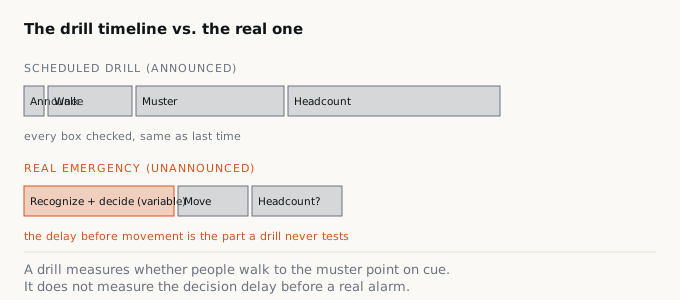
Ten o’clock, second Tuesday of the quarter. The alarm sounds, and nobody in the building has to ask what it means, because the memo went out Friday. People save their work, grab a jacket if it’s cold, and walk the route they walked last quarter. The warden clicks a clipboard at the muster point, the number matches the badge count, and the log gets filed. On paper, the building just proved it can evacuate. What it actually proved is that people can follow a known cue to a known destination on a known schedule. That is a real skill. It is not the skill a real emergency asks for.
What a scheduled drill actually tests
Break an evacuation into two pieces: the decision phase (does this signal mean something is wrong, and what do I do about it) and the movement phase (walking from where I am to where I’m supposed to be). A drill announced in advance collapses the decision phase to zero. Everyone already knows the alarm is coming, already knows it’s not real, and already knows the correct response. What gets timed and logged is only the movement phase, the easiest and most forgiving part of the whole sequence.
That distinction is not editorial. It’s the finding behind NIST’s research modeling pre-evacuation delay among World Trade Center occupants on September 11, 2001, which concluded that the pre-evacuation period, especially the phase where people interpret a threat and decide it’s real, can run significantly longer than the physical movement time that follows. A drill log has nothing to say about that phase, because a scheduled drill removes it entirely.
NIST’s own guidance on using drill data for evacuation research says the same thing from the other direction: fire drill data is commonly used as a stand-in for real emergency behavior, but that substitution depends on whether occupants are actually exposed to smoke or fire cues, meaning drill data best approximates the reaction of people who were never close enough to a real hazard to have to interpret it as one. A predictable, no-stakes drill is, by definition, that population.
The regulatory floor is a floor, not a ceiling
OSHA’s Emergency Action Plan standard, 29 CFR 1910.38 (US, general industry), requires a written plan covering reporting procedures, evacuation and exit-route assignments, procedures for employees who stay behind to shut down critical operations, procedures to account for all employees after evacuation, rescue and medical duties, and a named point of contact. It requires an employee alarm system with a distinctive signal, and it requires that employers designate and train people to assist in evacuation. It does not require the drill itself to be unannounced, does not require variable timing, and does not require that any exit other than the primary one gets used. Meeting 1910.38 tells an inspector the plan exists and was reviewed. It does not tell anyone how the workforce behaves when the signal is unexpected.
NFPA’s guidance on emergency egress and relocation drills is more direct about the gap: drills are required by occupancy classification under NFPA 1 and NFPA 101, and the guidance itself flags that predictable, always-announced drills train people to respond to the drill, not to the event. NFPA 101’s healthcare occupancy chapters go further and require drills to simulate emergency conditions, not just calendar them, which is itself an admission that a scheduled walk-through and a simulated emergency are different tests measuring different things.
Monday morning check
Pull your last drill log and your last EAP review together. If every entry lists a fixed date, a fixed time, and the same exit route used every time, you have documented compliance with the drill, not capability to respond to the event. **When was the last time your alarm sounded on a date nobody in the building knew in advance?**
The headcount problem nobody schedules for
1910.38(c)(4) requires “procedures to account for all employees after evacuation.” Read that clause literally: employees. Not visitors, not contractors, not the delivery driver in the loading dock, not the auditor sitting in a conference room who isn’t on anyone’s shift roster. A scheduled drill, run at 10am on a normal business day with normal staffing, rarely stress-tests that gap, because the people most likely to be missing from a badge-based headcount (visitors, contract crews, vendors) are the people least likely to be treated as part of the exercise in the first place. A real event at an unpredictable hour, with a different visitor mix and a different subset of staff on-site, is exactly when that accounting procedure gets tested for real, and exactly when most programs have never rehearsed it.
Where the actual gap gets closed
None of this argues against drills. It argues against mistaking the easy version for the hard one. A few concrete moves separate a program that produces evidence from one that produces theatre:
Vary the exit used. If the primary stairwell is always the one people walk during drills, that’s the only exit anyone is fluent in, and it’s the one most likely to be compromised in a real fire.
Vary the timing enough that recognizing the alarm, not just responding to a known cue, is actually being exercised. NFPA’s own commentary on egress drills treats unpredictability as part of what makes a drill useful rather than a training gap.
Build a visitor and contractor accounting step into the procedure itself, not as an afterthought bolted onto the employee count. If your sign-in log isn’t cross-checked at the muster point, you don’t have an accounting procedure, you have an employee accounting procedure with a blind spot.
Separate the compliance record from the capability record. A completed drill log satisfies the paperwork. It should never be read, internally, as evidence that the building’s population can recognize, decide, and move correctly under conditions the drill was specifically designed not to include.
The spine of this publication is that compliance is not safety. A drill log is compliance. What happens the one time the alarm goes off and nobody sent a memo first is safety, and it’s the only version of the test that actually counts.