The drone saw the tank. It did not enter it.
Inspection drones genuinely cut hazardous entries and work at height for the look, but a camera sees surfaces, not what is behind them, and it never removes the entry that repair still requires.
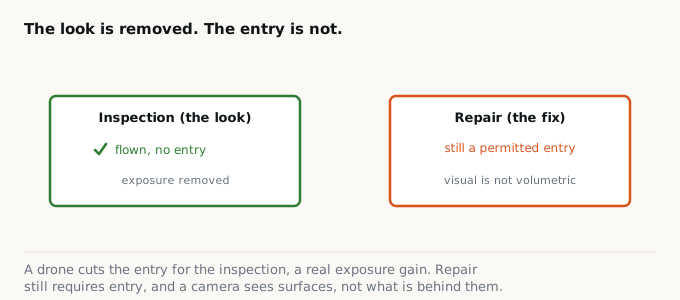
An inspection drone flies up the inside of a flare stack, tracks the seams of a storage tank, and skims a roof that would otherwise need a lift and a harness. Nobody stood on the edge. Nobody signed an entry permit. That is not marketing; it is a real reduction in exposure, and it deserves credit. The mistake comes next, when the clean footage gets treated as if the space has been fully assessed. A drone changes who takes on the hazard for the look. It does not change what the job still requires once you find something.
What the drone actually removes
The strongest case for inspection drones is that the highest-consequence hazards in access work attach to the human being in the space, not to the looking itself. Confined-space entry under 29 CFR 1910.146 exists because tanks, vessels, and stacks expose an entrant to toxic and explosive atmospheres, oxygen-deficient atmospheres, and engulfment. Work at height sits under 29 CFR 1926.501, which requires fall protection for employees “6 feet or more above lower levels.” Every one of those hazards is a function of a person being there. Remove the person from the routine visual and you remove the exposure for that task. That is genuine, and it is the whole reason to fly one.
Exposure reduction is real, and it is the point
The honest version of the value proposition is narrow and strong: a drone lets you do the periodic look without the permit, the atmospheric risk, the attendant, the retrieval gear, and the fall exposure that the same look used to demand. A tank interior surveyed by air is a confined-space entry that did not happen. A stack crown photographed from a hover is time not spent clipped to an anchor at height. Fewer entries and less time at height are not dashboard metrics; they are exposures that did not occur. Under the hierarchy of controls, moving the person out of the hazardous location is elimination for that task, which ranks above any procedure or personal protective equipment you would otherwise layer on.
But the look is not the job
Here is where the false sense of completeness sets in. Inspection is not repair. The moment the drone finds a cracked weld, a corroded plate, or a fouled internal, someone still has to enter to fix it, and that entry carries the full weight of 1910.146 or the fall-protection rules the flight appeared to retire. The drone did not remove the entry. It deferred it, and it told you it was necessary. A program that counts the flight as the completed job, rather than as the trigger for a properly permitted entry, has quietly converted a safety gain into a paperwork gap.
Visual is not volumetric
The second limit is physical. A camera returns surfaces, not substance. It sees the outside of a plate, not the wall thickness behind it; the visible face of a weld, not the fatigue crack under the coating; the top of a residue layer, not what is trapped below it. Corrosion under insulation, internal wall loss, and subsurface cracking are exactly the failure modes that visual inspection alone was never designed to catch, and they are frequently the ones that matter most for integrity. A confident, high-resolution image of a surface can read as reassurance while telling you nothing about the condition that will actually fail. The drone answers “what does it look like,” not “how much sound material is left.”
None of this argues against flying. It argues for scoping the flight honestly: a drone is an excellent way to decide whether and where a human needs to go, and a poor way to conclude that no human needs to go at all.
Before you invest
Before you treat a drone inspection as equivalent to entry, ask: does this task need someone to touch, measure, or repair the asset, or only to look at its surface, and does the failure mode I am worried about live on the surface or behind it? If the answer involves hands-on work, thickness or volumetric data, or anything behind the visible surface (wall loss, corrosion under insulation, subsurface cracking), the drone is a scoping tool that informs a still-required entry, not a substitute for it. Buy it to reduce how many entries you make and to aim the ones you keep. Do not buy it as a way to declare an entry unnecessary.