The guard passed the audit. The bypass is still running.
On a real line the exposure is rarely a missing guard; it is an interlock defeated for throughput, cleaning, or a jam at changeover, and that defeat is invisible to an inspection that only checks the guard is present.
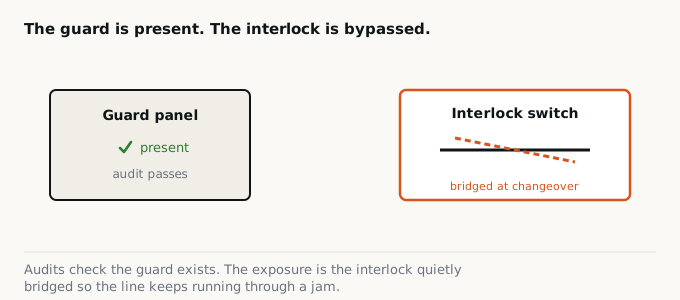
Walk a plant with a clipboard and you will find the guards. They are bolted on, painted safety yellow, listed on the checklist with a tidy row of checkmarks. The audit closes clean. And somewhere on that same line, a fixed guard is being lifted a dozen times a shift, or an interlock is held closed with a spare actuator taped inside a control panel, because the machine will not clear a jam with the door shut and the line has a number to hit.
That gap is the point. Compliance measures whether the guard exists. Safety depends on whether the guard is doing its job every hour of every shift, including the hours nobody is watching. On real lines the failure mode is almost never a missing guard. It is a present guard that has been quietly defeated.
Where the two standards meet
Two OSHA standards govern this, and the seam between them is where the trouble lives.
29 CFR 1910.212 is the general machine guarding rule. It requires that the point of operation and other hazard zones be guarded so no part of an employee’s body can enter the danger zone during the operating cycle. That is a running-production requirement. It assumes the machine is producing.
29 CFR 1910.147, the lockout/tagout standard, governs servicing and maintenance, where the exposure is unexpected energization or startup. But it carves out a “minor servicing exception” for activities that are routine, repetitive, and integral to production, things like minor tool changes, adjustments, and clearing jams. Here is the part people skip: that exception only applies if the work is done with alternative measures that provide effective protection, such as interlocked barrier guards or presence-sensing devices. And OSHA has been explicit that the employer bears the burden of proving, case by case, that the exception actually applies.
Read those two together and the picture sharpens. Clearing a jam through an interlocked door, without locking out, is legal only because the interlock is the control. Defeat the interlock and you have not taken a shortcut. You have removed the one thing that made the shortcut lawful in the first place, and you are now doing energized servicing with no protection at all.
Why people defeat guards
Nobody defeats a guard out of malice. They defeat it because the guard is in the way of the job.
This is well enough understood that the international standard on guard interlocks, ISO 14119, devotes a whole clause to it. The standard states plainly that a machine “shall be designed in such a way that it minimizes the motivation for defeating the interlocking devices,” and that an interlock should cause “the minimum possible interference with activities during operation and other phases of machine life.” Translation: if the safe way is the slow way, people will find the fast way. The defeat is a design signal, not just a discipline problem.
The domestic safeguarding standard, ANSI B11.19, sets the performance bar for what a real safeguard has to do: an interlocked guard must prevent access until the hazard has ceased, and the interlock device itself must be built for safeguarding, not a repurposed limit switch. A held-closed door or a bridged switch fails that test even when the guard panel is physically intact.
And the reason this matters is that changeover, cleaning, and jam-clearing are exactly the moments when hands go where the hazard is. NIOSH fatality investigations return to this pattern again and again: a worker reaching into a machine to clear a jam or make an adjustment, an interlock that had been bypassed, and a startup that should have been impossible. The guard was there. The protection was not.
Finding the defeat on a walk
You cannot find a defeated interlock from a checklist, because the checklist asks whether the guard is present and the answer is yes. You find it by watching the work and reading the wear.
Field check
Pick your highest-throughput line and stand at the changeover or jam-clear point during an actual change, not a scheduled demo. Watch hands and doors. Then ask the operator the only question that matters: "When this jams at 2 a.m. and you're behind, what do you actually do to clear it, and does the machine keep running while you do?" If the honest answer involves reaching past a guard without a lockout, or a door that "we leave cracked," you have found your exposure regardless of what the audit said.
Back that conversation with physical tells. Look for actuators, keys, or spare tongues stored near the machine instead of on the guard. Look for tape residue, zip-tie stubs, or a magnet parked next to a safety switch. Look at guard hinges and edges: a fixed guard that is genuinely never opened does not have polished bolt heads and a worn paint line. Pull your lockout logs and compare them against production reality, if a machine runs three shifts and jams routinely but almost never appears in the lockout record, the jams are being cleared some other way.
None of this shows up as a citation until someone is hurt. The guard that passes the audit is not the safe one. The safe one is the guard that people cannot get their job done faster by defeating, and that is a bar no clipboard measures.