Scoring ten thousand postures does not move one workstation
Automated posture scoring removes a bottleneck that was never binding. Ergonomics programs are limited by the rate of job redesign, so a vision deployment should be judged on redesigns shipped, not assessments generated.
A disclosure before the argument, because it belongs in the open: the operator of this publication has affiliated business interests in the automated vision safety category this piece examines. That is precisely why the standard here is evidence and independence, not enthusiasm. If the argument below cuts against the category, so be it. The floor does not care who is selling.
Ergonomic assessment has always been rationed by labour. Someone trained had to stand at a station with a clipboard, watch a cycle, score the postures, and write it up. That cost meant assessments were done on the jobs someone already suspected, after someone was already hurt, and rarely repeated. The methods themselves are well established and openly published: RULA, introduced by McAtamney and Corlett in Applied Ergonomics in 1993, and REBA, introduced by Hignett and McAtamney in the same journal in 2000, alongside the NIOSH approach to lifting set out in the Applications Manual for the Revised NIOSH Lifting Equation.
Pose estimation from ordinary video changes the economics of that first step completely. A camera can score every cycle on every shift, produce trends, flag which stations sit in the red, and never get tired or drift between assessors. This is a real capability and the direction of travel is not in doubt.
The question worth asking now, before the budget cycle rather than after it, is whether assessment volume was ever the thing holding these programs back.
The bottleneck was downstream
Musculoskeletal disorders remain one of the largest categories of serious nonfatal work injury, and the national picture is published each year by the Bureau of Labor Statistics. Ask an EHS director why their MSD numbers have not moved and the answer is almost never that they do not know which jobs are bad. In most plants the answer comes back in seconds, and it is the same three or four stations everyone has known about for years.
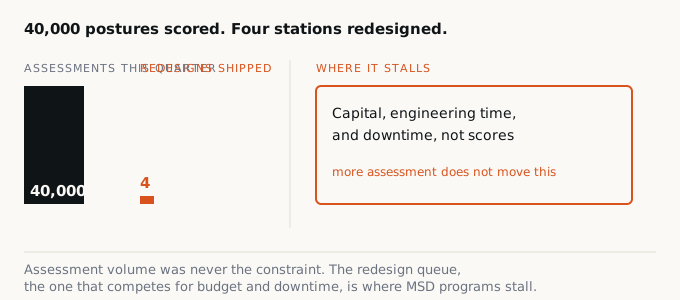
They know because operators told them, because those stations generate the complaints, the restrictions, and the claims. What has not happened is the redesign. The fix is a lift table, a height-adjustable fixture, a reoriented conveyor, a tool change, a rotation schedule, or a layout change on a line that is running. Each of those competes for capital, for engineering time, and for production downtime. That competition, not the shortage of scores, is where ergonomics programs actually stall.
Automating assessment relieves a constraint upstream of the one that binds. The predictable result is a system that produces far more evidence for a conclusion nobody was disputing.
The failure mode has a precedent
This publication has looked before at what happens when a safety program adopts a metric it can generate cheaply: the observation count becomes the deliverable, and the volume of observations grows while the injury rate does not. Automated posture scoring can recreate that pattern in a more sophisticated form, and more dangerously, because the output looks quantitative and objective.
Three specific risks are worth watching for.
Score inflation as an end in itself. A dashboard showing 40,000 postures assessed this quarter is an activity number. It reports effort, not exposure reduction. It is also very easy to present upward, which is exactly why it tends to survive.
Method drift. RULA and REBA were built for a trained observer scoring a representative cycle, with judgment about what is representative. Applied continuously and automatically, the outputs are only as meaningful as the camera angle, occlusion handling, and the segment of work being captured. A high-confidence score on a partially occluded operator is a number, not a measurement. Ask what the system does when it cannot see the hands.
Displacement of the operator’s account. The person doing the job knows which motions hurt, which shift is worse, and what workaround they have adopted. That information does not appear in a posture angle. A program that starts trusting the score over the operator has lost its best sensor.
What a serious deployment looks like
The useful version of this technology is narrow and honest about its role: it is a triage and verification instrument, not a decision-maker. Triage, in the sense of surfacing the stations nobody had flagged, particularly in low-visibility areas, on off-shifts, and in short-cycle work where the risk accumulates in ways an occasional walkthrough misses. Verification, in the sense of measuring the same station before and after a redesign and showing whether the change actually removed the exposure or moved it somewhere else. That second use is where the technology earns its cost, because before-and-after evidence is exactly what a capital request for the next lift table needs and rarely has.
Before you buy the cameras
Take the last four quarters of your ergonomics program and count two numbers: the assessments completed, and the physical job changes actually implemented. Then ask: if we could assess every station continuously starting tomorrow, how many more redesigns would we ship this year, and what would fund them? If the redesign count is already far below the assessment count, assessment is not your constraint and more of it will not move MSDs. Follow with the accountability question: who owns the queue between "station identified as high risk" and "station changed," what is the current median time through that queue, and does anything in this deployment shorten it. If the honest answer is that findings will land in the same backlog, you are buying a faster way to fill a queue you already cannot clear.
The technology is genuinely improving and the triage case is real. Just size the purchase against the bottleneck you actually have. A program that redesigns four stations a year and assesses forty does not become safer by assessing four thousand.