A prequal grade vets the paperwork, not today's crew
A contractor's prequal score rates its history and programs; it cannot tell you whether today's specific crew is trained, competent, and working safely on your site.
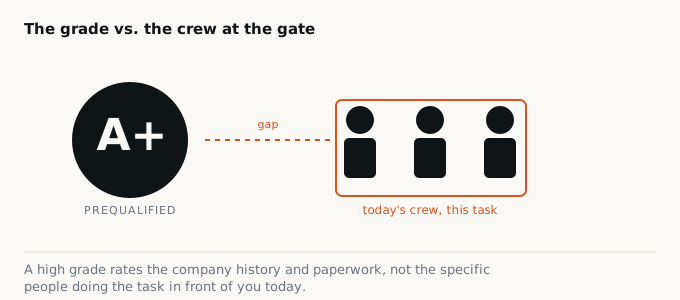
Contractor prequalification does something useful. It filters out firms with terrible injury histories, absent safety programs, and lapsed insurance before they ever reach your site. As a screen it earns its keep. The problem starts when the grade stops being a screen and becomes a substitute for verification. A high prequal score describes a company’s past and its documents. The hazard on your site today is created by a specific crew, on a specific task, under a specific supervisor, none of which the score can see.
That gap is where the false sense of control lives.
What the grade actually measures, and what it cannot
A prequal score is built from historical and documentary inputs: recordable and lost-time rates, EMR, citation history, written programs, training matrices, insurance certificates. Every one of those is a lagging or paper indicator. A firm can carry a low incident rate and a binder full of programs and still send you three people who have never done this task in this configuration, supervised by someone who arrived an hour ago.
The grade cannot tell you who is on site today. It cannot tell you whether the person operating the aerial lift is the one whose card is in the training file. It cannot tell you whether the crew read the job hazard analysis or whether one exists for the actual scope. Prequalification rates the organization. Work is performed by individuals, and OSHA’s obligations attach to the individuals and the conditions, not to the org chart.
OSHA puts the duty on you regardless of the grade
Here is the part the score does not change: your legal exposure. Under OSHA’s Multi-Employer Citation Policy (CPL 02-00-124), more than one employer can be cited for a single hazardous condition, and a controlling employer, one with general supervisory authority over the worksite including the power to correct violations or require others to correct them, must exercise reasonable care to prevent and detect violations on the site. A host that directs contractor work generally sits in that category.
Read the reasonable-care factors in the directive and notice what they reward. The frequency and closeness of your oversight is supposed to flex with what you actually know about this contractor’s practices and history. The directive says less-frequent inspection may be appropriate where the host sees strong indications of an effective safety effort, and the most important indicator it names is a consistently high level of compliance observed on the job. That is on-site observation, not a prequal certificate. A grade you bought from a database is not the reasonable care the policy describes.
Where highly hazardous chemicals are in play, the standard is even more prescriptive. OSHA’s Process Safety Management rule, 1910.119(h), requires the host to obtain and evaluate information on a contract employer’s safety performance when selecting it, to inform contractors of the process hazards, and to maintain an injury log for contractor work in the process area. Selection is one duty. Ongoing information exchange and oversight are separate, continuing duties. Prequal satisfies the first and none of the rest.
The point-of-work verification
Regardless of prequal grade, at the start of a task walk up to the actual crew and ask: can this specific crew show me, for this specific task, the trained-competent person doing it and the hazard analysis they are working to? Concretely: names on site match the training records for the equipment in use; a task-specific JHA exists and the crew can describe its top hazard and control; the on-site supervisor knows your site's hazards and emergency procedures; and required permits (hot work, confined space, energy control) are filled out for today, not photocopied from last week. If a prequal-platinum contractor cannot produce these at the point of work, the grade protected nobody.
Use the grade for what it is
None of this argues against prequalification. Screening out demonstrably unsafe firms is worth doing, and evaluating a contractor’s safety record is exactly what PSM’s selection provision requires. The error is treating a passing grade as a completed control rather than an entry ticket.
Two habits keep the grade in its place. First, decouple selection from field verification in your own procedures, so that “prequalified” never appears as the closeout on a hazard the crew still has to manage in real time. Second, calibrate your oversight to what you observe, not to what the database scored, which is precisely what CPL 02-00-124’s reasonable-care factors reward. The contractor whose crews consistently pass point-of-work checks earns lighter touch. The one whose grade is high but whose crews cannot produce a task JHA earns more of your attention, not less. The grade opens the gate. Watching the work is still your job.