The danger lives in the seam between employers
On mixed sites, incident risk concentrates at the interface between employers, who owns that seam predicts outcomes more than either party's own program.
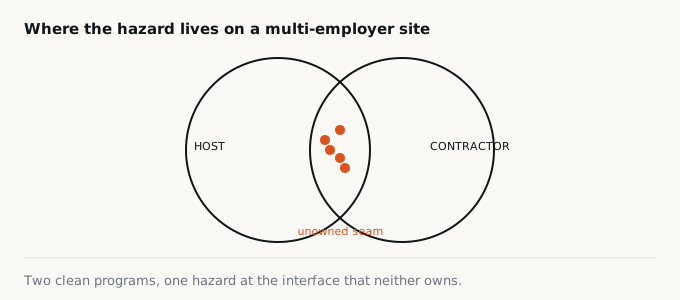
Walk any mixed site and you can usually tell which crews run a tight program. What you cannot tell by looking is where the next incident will come from, because it rarely comes from inside a good program. It comes from the space between two of them. A permit the host issued but the sub never read. A guard the general removed and assumed the specialty crew would replace. A confined-space entry where three companies each believed a fourth was watching the atmosphere. That is the seam, and the seam is where people get hurt.
Both employers can be right and someone still gets hurt
Two competent employers can each run a clean program and still leave a hazard unowned at the boundary where their work meets. Each assumes the other has it. Neither does. OSHA’s Multi-Employer Citation Policy (CPL 02-00-124) anticipates this: a single hazard can cite the employer who created it, the one whose workers were exposed, the one responsible for correcting it, and the one with general control. Four roles, one hazard, on a bad day, four different companies, none of whom thought it was theirs. Liability tracks authority over the interface, not the quality of anyone’s binder.
Ownership is the control, not coordination
The fix isn’t “better coordination,” which usually means nobody is accountable. It’s naming an owner for each interface before work starts. OSHA’s host/contractor coordination guidance puts the burden on the host to make hazards, controls, and reporting paths explicit before a contractor arrives, in the contract, not a toolbox talk. Who locks out the shared panel. Who tests the atmosphere the sub enters. Who owns the scaffold after the erector demobilises.
Field check
Pick one hazard that sits between two crews, a shared energy source, a scaffold changing hands, a joint confined space. Ask each employer, separately: "Who owns controlling this specific hazard right now, by name?" Two different answers, one answer, or a shrug, you've found your next incident.
Your incident log isn’t a list of bad programs. It’s a map of unowned seams. (US framework; state-plan states apply equivalents.)