More alarms, slower response
Past a threshold, adding alerts raises response latency instead of lowering it.
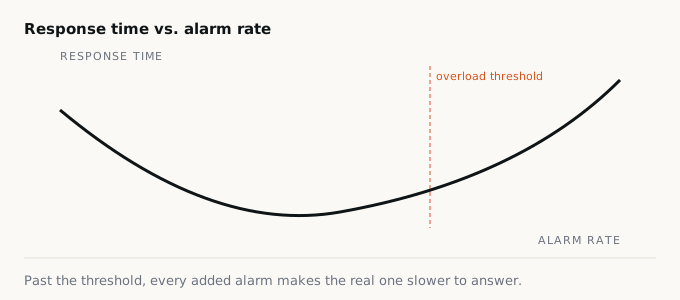
The pitch for connected-worker gas detection is intuitive: every reading streams to a dashboard, every excursion raises an alert, and someone always knows. More visibility, more alerts, more safety. The first two are real. The third does not follow. Response is a human act, and humans have a finite budget for alerts. Spend past it and the thing you bought to speed response starts to slow it.
The curve bends the wrong way
Alarm-management practice has quantified where the budget runs out. EEMUA 191 and ANSI/ISA-18.2 (IEC 62682) treat alarm rate itself as a safety variable. The long-observed benchmark: a steady-state rate under roughly one alarm per ten minutes per operator is manageable; more than one per minute is very likely unacceptable, because the operator can no longer process each alarm and act. Every alert above that line competes for the same scarce attention, and the operator stops treating alarms as signals to act on. That is alarm fatigue, and its symptom is delay: acknowledge-and-clear, not assess-and-respond.
A connected-worker platform pushing routine telemetry, low-battery notices, brief bump-test flags, transient near-threshold readings that self-clear, can quietly drive the alarm rate up the wrong side of that curve. When a genuine H₂S excursion finally arrives, it lands in a stream the responder has already learned to dismiss.
Coverage is not response
Under OSHA’s permit-required confined spaces standard, 29 CFR 1910.146, continuous monitoring exists so an alarm triggers immediate evacuation and rescue (US). The regulation assumes the alarm still commands a response. A dashboard that logs the excursion perfectly but reaches a desensitised attendant has satisfied the sensor and defeated the standard.
Before you buy
Ask the vendor for the platform's expected alarm rate per monitored worker per hour under normal operation, counting every notification, not just gas alarms, and how many require a human action. If they can't produce it, or it clears one per ten minutes, the system is engineering the fatigue that will swallow the real alarm.
Judge an alerting platform on response latency to real excursions, not the completeness of its log. Before adding a channel, prune one.