A gas map is only as fast as who answers it
Networked gas sensors can turn point readings into a live area exposure map, but the value is set by alarm routing and who owns the response, not by how many sensors you hang.
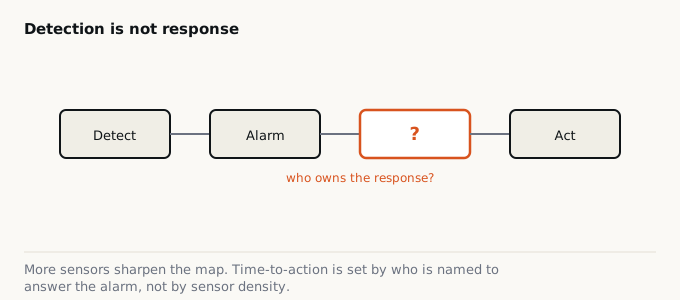
Here is the picture the connected-detection future is selling, and it is a genuinely good one. Instead of a lone entrant staring at a four-gas meter, you get a live atmospheric map of an area. Fixed and wearable sensors stream readings to a common view, and a rising hydrogen sulfide plume shows up as a moving stain on a floor plan before anyone downwind can smell it. Point readings become a picture. That is a real gain, and it is coming fast.
I have been watching this shift with interest, because it changes what atmospheric monitoring can see. A single meter answers one question: is the air around this one worker safe right now. A networked array answers a bigger one: where is the hazard, which way is it moving, and who is in its path. For confined-space work and area gas hazards, that spatial view is the part that could actually move the fatality numbers.
The hazard the map is built for
The reason to care is not novelty. It is the hazard profile. NIOSH’s long-running work on confined-space deaths, going back to its foundational alert on the subject, found that hazardous atmospheres are the dominant killer, and that a large share of the dead are would-be rescuers who entered to help and were overcome by the same air. These are events that unfold in seconds, faster than a person can reason about them, which is exactly why continuous atmospheric awareness matters.
OSHA already anticipates this. The permit-required confined space standard, 1910.146, requires testing the atmosphere before entry and monitoring it during entry, and it fixes the test order for a reason: oxygen first, then combustible gases and vapors, then toxics, because a combustible-gas sensor needs adequate oxygen to read true. Connected detection does not change that logic. It extends the monitored zone outward from the entrant to the whole area, and it lets the reading reach people who are not standing next to the meter.
Where the value actually lives
Now the part the pitch tends to skip. A live gas map does not save anyone. A response does. The sensor detects; a human decides and acts. Everything that makes connected detection worth the money happens in the gap between the alarm firing and a person doing something about it, and that gap is a design problem, not a hardware problem.
OSHA 1910.146 is blunt about where responsibility sits. The attendant’s job is to monitor conditions and to summon rescue as soon as entrants may need help to escape, and to perform no duty that interferes with watching over them. Notice that the standard assigns the response to a named person with an undivided task. A network of sensors does not relieve anyone of that. If an alarm routes to a screen no one is assigned to watch, or to five people who each assume another will act, the added sensor density bought you nothing. You have made the hazard more visible and left the response ambiguous, which can be worse than a single meter held by one person who knows the alarm is theirs.
So the density question is the wrong first question. More sensors sharpen the map. They do not shorten the time to action. That number is set by three things: where the alarm goes, who is named to answer it, and whether that person has the authority and the clear path to evacuate or summon rescue without waiting for a decision from someone else. Density is a spatial-resolution setting. Response ownership is the safety control.
Before you invest
Before you price a connected gas-detection system, sketch the response, not the coverage. When a wearable alarms in the field at 2 a.m., trace the signal: which specific person or role receives it, what they are required to do within the first sixty seconds, and who has the authority to order an evacuation. If you can name the sensors on the map but not the one person who owns the response to each alarm, you are buying resolution, not protection.
The question worth carrying forward
I am optimistic about connected atmospheric monitoring, and I think area gas mapping will become normal equipment for the work that kills people quietly. But the technology reveals a truth the older gear let us ignore. Detection was never the hard part. Deciding, fast, with a named owner and a clear line to act, always was. Buy the sensors when you have answered that. Not before.