Computer vision's real job isn't watching for hard hats
PPE detection is the easy, low-value use of vision. Struck-by events are among the incidents that actually kill people, and that is where vision has to prove it can see a person in the line of fire.
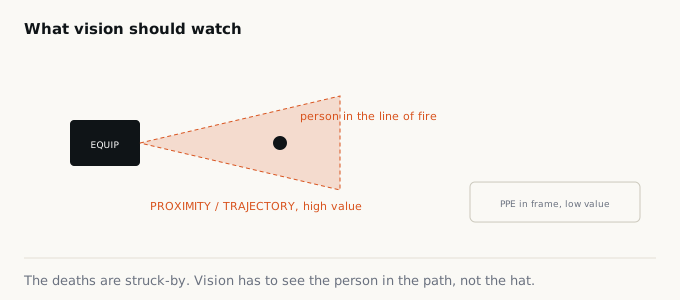
Walk any site running a vision pilot and you’ll find the cameras doing the same thing: flagging people without hard hats or vests. It demos well and scores easily, the object is either on the head or it isn’t. But when did a missing hard hat last kill someone on your site? PPE non-compliance is real, but it’s rarely the mechanism of a fatality. The mechanism is a person and a moving mass occupying the same space.
The value is in the line of fire
NIOSH’s work on struck-by hazards is blunt about where the deaths come from: contact between a worker and an object or equipment, with transportation incidents alone a large share of fatal struck-by injuries in construction (NIOSH struck-by resources). The contributing factors are spatial and perceptual, blind spots, noise, degraded awareness, exactly the conditions a well-placed camera could read that a human operator cannot.
That reframes the question from “is the PPE on” to proximity, exclusion-zone violation, and trajectory, is a person in the swing radius, the back-up path, the cone where the load is heading. This is what the ANSI/ASSP A10 construction series exists to control, and it’s the harder engineering problem: real distance and motion from a 2D image, in dust and glare, with false alarms low enough that operators don’t switch it off.
Detection is only half of what NIOSH describes
NIOSH frames collision prevention as two steps: early detection of risky proximity, then action to prevent contact. Detection is the part vision could own. The second step is where most deployments quietly stop, and it is the step that decides which tier of control you have actually bought.
If the system detects a person in the path and sounds an alarm for a human to respond to, you have added an administrative control. It depends on somebody hearing it, interpreting it correctly, and acting in time, which is the same dependency that failed in the incident you are trying to prevent. If the system detects a person in the path and slows or stops the machine itself, you have an engineering control, and you have moved up the hierarchy rather than sideways along it.
That distinction should decide the purchase. A vision system wired to a horn is a better horn. A vision system wired to the drivetrain or the hydraulics is a different class of thing entirely, with a correspondingly harder integration, functional-safety and validation burden. Vendors rarely draw the line clearly, because the first is far easier to sell and install.
Latency and false alarms decide whether it survives
Two numbers determine whether any of this works in practice, and neither appears on a product sheet.
The first is time. An alarm is only useful if it arrives early enough for the intervention to complete. That means detection range has to exceed the machine’s stopping distance plus whatever reaction time the response actually requires, at the speeds the equipment really travels on your site rather than the speeds in the specification. A warning that fires half a second before contact is a recording of an incident, not a prevention of one.
The second is nuisance. Every proximity system faces the same trade: tune it sensitive and it fires constantly in congested areas, tune it conservative and it misses the case that mattered. Fire too often and the outcome is entirely predictable, because it is the same outcome as every other over-alarmed system. Operators stop treating alerts as information, then find a way to work around them. A collision-avoidance system that operators have learned to override is worse than none, because it appears on the risk register as a control.
The test
For any vision deployment, ask: would this system have raised an alarm before your last serious incident, and would it have arrived early enough to act on? If the tool only detects PPE state, the honest answer is no, it was never watching the hazard that hurt people.
Measure it against your own logs
Measure a deployment against the incidents in your own OSHA logs, not detection accuracy on a benchmark unrelated to your fatalities. Green hard-hat metrics can coexist with a site where the real exposure, people in the path of moving equipment, is never observed at all.
The practical version of that is a short exercise anyone can run before a vendor conversation. Pull the last five years of struck-by events and high-potential near-misses. For each one, write down what a camera would have had to see, from where, and how long before contact. Some will turn out to be genuinely observable and are the case for the investment. Others happened inside a machine, behind a wall, or in the two seconds after a load shifted, and no camera position solves them.
That list is the specification. Walk into the demo with it, and the conversation stops being about detection accuracy on someone else’s benchmark and starts being about your own fatalities.