Chained Is Not Compliant: The Cylinder Audit That Checks the Wrong Thing
A storage area can pass every cylinder-securement check, chained, upright, capped, while running oxygen and fuel-gas cylinders closer together than federal law allows, because most walkthroughs verify that cylinders are secured, not that they are segregated or identified.
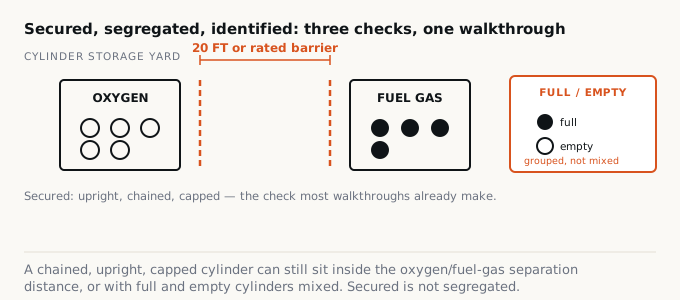
A maintenance yard cylinder cage passes its monthly safety walk without a mark against it. Every cylinder is upright, chained to a rack, valve caps on the ones not in use. The auditor signs off. Eight feet away from the oxygen rack sits the acetylene rack, no fire-rated barrier between them, no 20-foot gap, just a painted line on the concrete. Nobody flagged it, because nobody was checking for it. The checklist asked whether the cylinders were secured. It never asked whether they were segregated.
That gap between what gets checked and what the regulation actually requires is the point of this piece: it is entirely possible to be fully “compliant” on the metric a walkthrough measures while sitting in violation of the metric that actually prevents a fire.
Three different questions, one checklist
Compressed gas cylinder storage sounds like a single control. It is actually three separate, independently verifiable conditions, and a site can satisfy any one of them without satisfying the other two:
- Secured: the cylinder is upright and restrained so it cannot fall, tip, or roll.
- Segregated: incompatible gases are kept the required distance apart, or behind a rated barrier.
- Identified: cylinders are labeled, and full stock is kept separate from empty stock.
Most site audits check the first one almost exclusively, because it is the fastest thing to verify visually: walk the row, look for chains or straps, confirm nothing is lying on its side. It is also the item most often written into internal safety scorecards as “cylinder storage compliant, yes/no.” Segregation and identification require knowing which gas is in which cylinder, measuring a distance, and checking a rating plate on a barrier, none of which a five-minute walkthrough is built to do.
What the regulation actually incorporates
The governing federal standard for general compressed gas storage is 29 CFR 1910.101, which requires that “the in-plant handling, storage, and utilization of all compressed gases in cylinders… shall be in accordance with Compressed Gas Association Pamphlet P-1.” OSHA does not restate CGA P-1’s content in the regulatory text; it incorporates the pamphlet by reference, which means the enforceable detail lives in an industry consensus document most site audits never open.
That document, CGA P-1, is explicit that securement and segregation are separate requirements. Section 3.3.3 states that “where gases of different types are stored at the same location, cylinders should be grouped by types of gas, and the groups arranged to take into account the gases contained, e.g. flammable gases should not be stored near oxidizing gases.” Section 3.5.3 goes further for the oxygen/fuel-gas pair specifically: “inside of buildings, stored oxygen and fuel gas cylinders should be separated by a minimum of 20 feet, or there should be a fire-resistive partition between” them. (Text as reproduced in the publicly archived edition incorporated by reference; see law.resource.org’s copy of CGA P-1.)
The specific number most EHS teams actually cite comes from a different subpart. 29 CFR 1910.253(b)(4), written for oxygen-fuel gas welding and cutting operations, states: “Oxygen cylinders in storage shall be separated from fuel-gas cylinders or combustible materials (especially oil or grease), a minimum distance of 20 feet (6.1 m) or by a noncombustible barrier at least 5 feet (1.5 m) high having a fire-resistance rating of at least one-half hour.” An OSHA standard interpretation on this section confirms the barrier has no fixed test protocol requirement (ASTM E119 is explicitly called inappropriate for barriers this small) but does need to be verified as noncombustible and rated by a qualified party, not just assumed. See the 2004 OSHA letter of interpretation on fire-resistant barrier design.
Two things follow. First, “20 feet or an equivalent rated barrier” is not a best practice pulled from a vendor’s poster; it is the operative distance under both the CGA P-1 provisions incorporated into 1910.101 and the explicit text of 1910.253(b)(4) for the oxygen/fuel-gas case. Second, a painted floor line, a shelf divider, or “they’re in different racks” satisfies none of it unless that divider is a verified noncombustible, fire-rated barrier at least 5 feet high.
For gas pairs beyond oxygen and fuel gas, such as other oxidizers stored near other flammable or reactive gases, NFPA 55, Compressed Gases and Cryogenic Fluids Code, sets hazard-class-based separation requirements. Verify the specific distance table for your gas classes and container sizes against the current edition directly, rather than a secondary source’s paraphrase, a mistake that compounds the exact problem this piece is about.
Identified is not the same as secured either
CGA P-1’s guidance also treats “identified” as a distinct control. Section 3.3.4 states that “charged and empty cylinders should be stored separately with the storage layout so planned that cylinders comprising old stock can be removed first with a minimum handling of other cylinders,” and section 3.1.11 calls for empty cylinders to carry an empty label or have the shipping tag’s lower portion removed. Under 1910.253(b)(2), the valve-cap requirement is unambiguous: “Valve protection caps, where cylinder is designed to accept a cap, shall always be in place, hand-tight, except when cylinders are in use or connected for use,” and “empty cylinders shall have their valves closed.”
A cage that mixes full and empty cylinders in the same rack, with no marking distinguishing them, can still be fully “secured,” chained, upright, capped on the ones not connected, and still fail identification. That matters operationally because an empty cylinder mistaken for full during an emergency response, or a full cylinder handled like scrap during turnover, is exactly the kind of error that securement checks are structurally blind to.
Why the gap persists
None of this is because the standards are unclear. It persists because “secured” is a binary, visual, five-second check, while “segregated” and “identified” require the auditor to know the gas classes present, carry a tape measure or verify a barrier’s rating documentation, and check labels cylinder by cylinder. A checklist optimized for speed will default to the binary check every time, and a program that only ever gets marked green on that check will never surface the other two failure modes until an incident forces the question.
The diagnostic
Walk every compressed gas storage location on site, cylinder by cylinder, and score three separate questions instead of one: is each cylinder secured against falling, is each oxidizer separated from each fuel gas or incompatible class by the required distance or a verified fire-rated barrier, and are full and empty cylinders visibly segregated with valve caps in place on anything not connected for use. Count violations on the second and third questions specifically, not just compliance on the first. If your last cylinder audit has a "compliant" result but no recorded measurement of the actual distance or barrier rating between oxidizer and fuel-gas storage, was segregation actually verified, or only assumed from the fact that nothing looked out of place?
A chained, upright, capped cylinder is not evidence that the storage area is safe. It is evidence that one of three required conditions was checked. The other two are cheaper to verify than the alternative.