The explosion that kills is the second one
The primary blast is rarely what kills. It lofts the dust that has settled on beams and ledges overhead, and that secondary explosion is the one that levels the building.
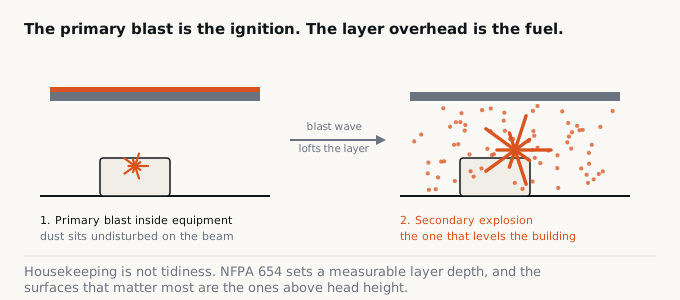
Walk a plant that handles sugar, flour, grain, wood, coal, aluminum, or plastic pellets and ask people where the dust hazard is. They point at a machine. The mill, the conveyor, the dust collector. They are pointing at the ignition. They are not pointing at the thing that kills them.
On February 7, 2008, a series of explosions tore through the Imperial Sugar refinery at Port Wentworth, Georgia, and killed fourteen workers. The US Chemical Safety Board investigation found that the first explosion happened inside an enclosed steel belt conveyor beneath the sugar silos, where recently installed steel cover panels had allowed sugar dust to reach an explosive concentration in a confined space. An overheated bearing most likely lit it.
Watch · US Chemical Safety BoardInferno: Dust Explosion at Imperial SugarThe CSB's investigation animation of the primary and secondary blasts. Opens on csb.gov in a new tab.That first blast did not kill fourteen people. What it did was shake the building.
The second explosion is the one that kills
Dust does not stay in the machine. Over months and years it drifts out and settles on the surfaces nobody looks at: roof beams, cable trays, conduit runs, the tops of light fixtures, ledges above head height. It sits there looking like dirt.
When a primary deflagration goes off, the pressure wave lifts all of that back into the air at once. In a fraction of a second a room that was merely dusty becomes a room filled with a suspended, ignitable cloud, and the flame front from the first explosion is right there to light it. The CSB found that the fourteen deaths at Port Wentworth most likely resulted not from the initial blast but from the massive secondary explosions and fires that propagated through the packing and refinery buildings.
Read the Board’s conclusion carefully, because it is the whole argument of this piece. The investigators judged that the secondary explosions, the rapid fire spread, and the deaths would likely not have occurred if the company had enforced routine housekeeping to remove sugar dust from overhead areas.
The fuel for the lethal event was not inside the machine. It was on top of it.
There is no OSHA combustible dust standard, and that is exactly the point
Here is where compliance and safety come apart. The United States has no comprehensive OSHA standard for combustible dust. Enforcement runs through the General Duty Clause, generic housekeeping requirements, and the Combustible Dust National Emphasis Program, a directive that tells inspectors where to look rather than telling you what to do. A facility can pass an inspection and still be carrying the fuel load for a secondary explosion on its rafters.
The real specification lives in the consensus standards. NFPA 652 requires a Dust Hazard Analysis, a structured examination of where dust can accumulate, disperse, and ignite, revisited on a defined cycle rather than once and filed. NFPA 654 supplies the measurable housekeeping threshold, and OSHA’s own letter of interpretation on accumulation depth walks through how to apply it: a layer thicker than roughly one thirty-second of an inch, about the thickness of a paperclip, covering more than about five percent of the floor area, with the allowable depth scaled to the dust’s actual bulk density.
Two things about that criterion trip people up. It is a measurement, not a vibe, so “the place looks clean” is not an answer to it. And the area it governs is not just the floor. Dust on overhead and concealed surfaces counts, because those are the surfaces a blast wave reaches first.
Field check
Stop looking at the equipment and look up. Pick the dustiest production area you have, get above head height, and run a finger along a roof beam, a cable tray, and the top of a light fixture. Then ask: if a pressure wave shook this building right now, how much fuel would come off the surfaces above our heads, and when did anyone last measure the depth rather than eyeball it? If your housekeeping procedure says "keep the area clean" instead of naming a layer depth, a percentage of area, and the overhead surfaces it applies to, you do not have a combustible dust program. You have a cleaning rota.
What actually holds up
Four things, in order of how much they matter.
A Dust Hazard Analysis that has been redone since the last time you changed the process. Housekeeping written to the measured criterion, explicitly including overhead and concealed surfaces, with a frequency derived from how fast dust actually accumulates in that room. Cleaning methods that do not create the hazard: blowing accumulations down with compressed air can suspend the exact cloud you are trying to prevent, which is why the standards constrain the practice rather than assume it. And ignition control on the equipment, because bearings, hot surfaces, and friction are where the first event usually starts.
There is one more lesson buried in Port Wentworth, and it is uncomfortable. The panels that enclosed that conveyor were installed to contain sugar and keep the plant cleaner. They worked. They also created a confined volume in which dust could reach an explosive concentration. A change made in the name of housekeeping built the primary explosion. If that change had gone through a management of change review that asked what new hazard the enclosure created, someone might have caught it.
The dust that kills you is not the dust you can see in the machine. It is the layer you have been walking under for six years, waiting for something to shake it loose.
US jurisdiction. OSHA enforces combustible dust hazards through the General Duty Clause and the National Emphasis Program rather than a dedicated standard; NFPA 652 and 654 are consensus standards. Confirm the requirements that bind your own jurisdiction and insurer.