The Chemical Cabinet Filed Like a Library
Storing hazardous chemicals in alphabetical order by product name optimizes for finding the bottle fast, not for what happens when an acid and an oxidizer end up shelved next to each other because their names start with the same letter.
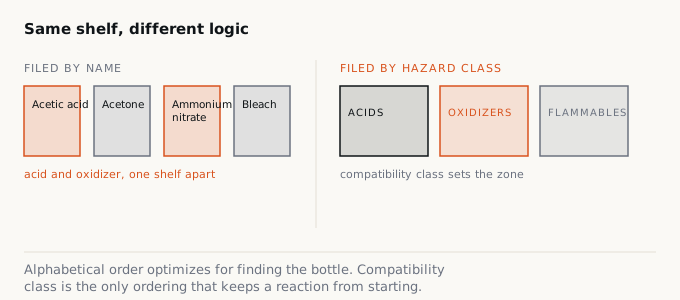
Walk into a chemical storage room that somebody clearly cares about and you’ll usually find it alphabetized. Acetone next to Acetic Acid next to Ammonium Hydroxide, working down the shelf the way a spice rack or a filing cabinet would. It looks tidy. It looks like someone thought about this. A new hire can find what they need in ten seconds, an auditor can scan the labels against a manifest without breaking stride, and the room reads as organized because, by the only standard most people apply to a shelf, it is.
It is also very often wrong, in a way that has nothing to do with tidiness and everything to do with chemistry. Alphabetical order is a retrieval system. It sorts on the first letter of a product name, a property that has zero relationship to how a chemical behaves near another chemical. An oxidizer and a flammable solvent can share a first letter and share a shelf. An acid and a chemical that releases toxic gas on contact with acid can sit six inches apart because their names happen to be neighbors in the dictionary. Nothing about the arrangement is checking for that. It was never designed to.
What the alphabet is actually optimizing for
Every storage scheme optimizes for something. Alphabetical optimizes for findability under time pressure: pull the SDS binder, find the product, walk to the shelf, done. That’s a real operational need and it’s not a foolish one. The problem is that findability and reactivity are two different sorting problems, and a room can only be sorted by one primary axis at a time unless you build in a second layer. Most rooms don’t. The alphabet becomes the only organizing logic in the space, and compatibility becomes something nobody checked because nothing in the room’s layout asked the question.
What the standard actually asks for
The relevant OSHA framework doesn’t specify a shelving algorithm, but it does specify where the compatibility information lives and what has to happen with it. Under the Hazard Communication Standard, 29 CFR 1910.1200, every hazardous chemical in the workplace has a safety data sheet, and OSHA’s mandatory SDS format puts handling and storage guidance in Section 7 and stability/reactivity data, including known incompatibilities, in Section 10. That information is chemical-specific by design. A room organized by name treats every SDS as interchangeable once the label is read; a room organized by hazard class treats Section 10 as the input that actually decides where the container goes.
For flammable and combustible liquids specifically, 29 CFR 1910.106 sets quantity limits and separation requirements for storage areas precisely because proximity to an incompatible material changes the risk profile of a leak or spill from “cleanup” to “ignition source.” The standard is written around hazard class, not product name, because that’s the variable that determines the failure mode.
Monday morning check
Walk your chemical storage area and pick any two containers sitting next to each other. Pull both SDSs and read Section 10 (Stability and Reactivity) for each one. If you can't say in under a minute whether those two chemicals are compatible on that shelf, **do you actually know why these two containers are neighbors, or did the alphabet decide it for you?**
The AB Specialty Silicones case
The gap between “labeled correctly” and “stored correctly” is not hypothetical. On May 3, 2019, an explosion at AB Specialty Silicones in Waukegan, Illinois killed four workers and injured a fifth. The U.S. Chemical Safety and Hazard Investigation Board’s final report found that an operator pumped an incorrect, incompatible chemical into a tank; that chemical had been stored in a drum nearly identical to the correct one, distinguished mainly by small labels. The resulting reaction produced hydrogen gas that released and ignited inside the production building. CSB’s own summary of the incident is blunt about the fix that was missing: written procedures calling for incompatible materials to be stored in different areas, with distinguishable containers, could have reduced the risk of exactly this kind of mix-up. This wasn’t a facility with no safety program. It was a facility where storage and identification practice hadn’t caught up to what the chemistry required, and the gap turned into a fatality event rather than a near miss.
Why alphabetical order keeps winning anyway
Compatibility-based segregation costs something that alphabetizing doesn’t: it requires someone to actually classify every product against NIOSH’s Pocket Guide to Chemical Hazards or the SDS Section 10 data, decide which hazard class it belongs to (acids, bases, oxidizers, flammables, water-reactives, and so on), and then hold the line when a new product arrives and the easiest place to put it is wherever there’s open shelf space. Alphabetizing self-maintains. Hazard-class segregation has to be maintained, because every incoming chemical is a small decision that someone has to make correctly, every time, including on the day the stockroom is short-staffed and the delivery truck is waiting.
That maintenance cost is also why segregation drifts back toward the alphabet over months, even at sites that set it up correctly once. A binder gets reorganized “for efficiency.” A relief worker restocks by matching the label to what looks like the nearest empty spot. Nobody actively decided to abandon the hazard-class scheme; it just eroded one convenient shortcut at a time; that a compliance program that manages hazardous materials under EPA’s Risk Management Program or a comparable accident-prevention framework is supposed to catch with periodic audits, but audits that check for labels and SDS presence, not shelf logic, will miss it every time.
What actually holds up
The fix isn’t a rule against alphabetizing. It’s accepting that alphabetical order is a subordinate index, not a storage plan. Segregate physically by hazard class first, using distance, secondary containment, or dedicated cabinets between incompatible groups, and only alphabetize within a compatible group once that’s settled. That ordering makes the room self-auditing: anyone doing a walk-through can check “is everything on this shelf in the same hazard class” as a single visual question, instead of having to cross-reference every product name against a reactivity table on the spot. Findability and compatibility stop competing once compatibility sets the zones and the alphabet just organizes what’s inside each one.
The uncomfortable part is that a room can look exactly as orderly, exactly as audit-ready, right up until two adjacent containers get opened on the same day.