An AR overlay is only as honest as the procedure behind it
Augmented reality can enforce a correct isolation sequence and cut skipped steps, but an AR overlay built on an outdated energy-control procedure is more dangerous than paper because it turns a wrong instruction into a confident one.
The promise: a sequence you cannot skip
Lockout/tagout is not a single act. OSHA’s control of hazardous energy standard, 29 CFR 1910.147, describes a documented sequence: prepare for shutdown, shut the machine down, isolate every energy source, apply lockout or tagout devices, release or restrain stored energy, then verify a zero-energy state before anyone touches the equipment. The failures that kill people are usually not exotic. They are skipped steps: a missed accumulator, a second feed left live, a verification that never happened because the worker knew the machine was dead.
This is exactly the kind of ordered, checkable task where augmented reality earns its place. A headset or tablet can pin the next required action to the specific disconnect in front of the worker, refuse to advance until a step is confirmed, and force the zero-energy check to be an explicit action rather than an assumption. Done well, AR turns a laminated procedure that lives in a binder into something that walks with the worker to each isolation point. It can enforce order, timestamp each confirmation, and make the periodic inspection that 1910.147 already requires far easier to evidence.
That is real. Step-enforced isolation is a plausible reduction in the most common lockout failure mode. But it rests on an assumption most safety pitches skip past.
The dependency: source-of-truth energy data
AR does not know how to isolate a machine. It renders whatever energy-control procedure it is handed, on whatever equipment it thinks it is looking at. Both of those inputs can be wrong.
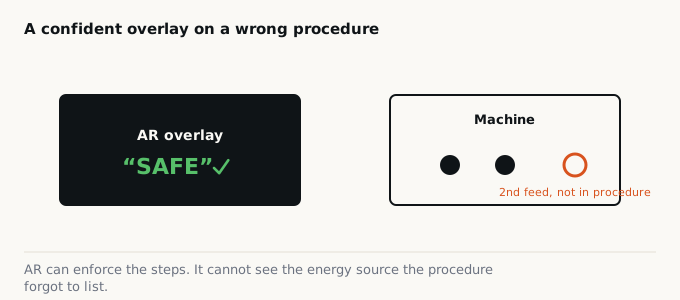
An energy-control procedure is only correct for the machine as it exists today. Plants modify equipment constantly: a hydraulic line rerouted, a pneumatic accumulator added during a retrofit, a second electrical feed installed for a new conveyor, a control transformer that keeps a circuit live after the main disconnect is opened. 1910.147 already anticipates this. It requires that procedures be documented and that periodic inspection correct deviations and inadequacies. The reason that requirement exists is that procedures drift out of sync with reality, and a procedure that omits an energy source is not a paperwork problem. It is a live hazard.
Paper has a quiet virtue here: it looks like what it is, a document that a competent worker reads with judgment and can distrust. AR removes that friction. A crisp overlay that says isolation complete, safe to proceed carries the authority of a verified system even when it is faithfully rendering a procedure that never accounted for the second feed. This is the ANSI/ASSP Z244.1 and ISO 14118 principle stated plainly: the goal is a genuine zero-energy state, all sources isolated, stored energy dissipated, re-energization prevented, and verified. An interface that asserts that state without the data to back it has not made isolation safer. It has made a wrong answer more convincing.
The failure is compounded by identification. If AR keys its procedure to a scanned tag, a QR code, or object recognition, then a mislabeled asset, a swapped nameplate, or two near-identical machines side by side can serve up the right procedure for the wrong equipment. The worker follows a flawless sequence for a machine that is not the one in front of them.
What this means for the reader
AR-guided isolation is worth watching and, for high-repetition or high-consequence maintenance, worth piloting. But the value lives almost entirely in the data layer, not the display. The right question is not whether the overlay is impressive. It is whether the energy-control procedure driving it is current, complete, and provably tied to the specific asset. Treat the AR system as a delivery mechanism for your procedures, and hold it to the same standard you already owe those procedures under 1910.147: verified, inspected, and corrected when the equipment changes.
Before you invest
Pick your five most-modified machines and ask: when the equipment was last retrofitted, what process guaranteed the energy-control procedure and its asset identifier were updated before the AR system would render them? If the answer is that the AR just shows whatever is in the file, you have automated the delivery of possibly-wrong procedures, not the verification of right ones. The overlay should be no more trusted than the last time a competent person walked that machine and confirmed every energy source.
AR can make the correct isolation sequence hard to skip, which is a real gain. It cannot make an incomplete procedure complete. Before it earns trust, the source of truth behind it has to earn trust first.