Nobody is driving, which is the point and the problem
Removing the human driver from a warehouse vehicle removes some errors and introduces new ones, so safety around AMRs now rests on validated, safety-rated sensing and the standard the vehicle was commissioned to, not on the word autonomous.
Powered industrial trucks are among the deadliest machines in the building. OSHA’s own materials put forklift-related fatalities at roughly 85 to 100 a year, with tens of thousands of serious injuries, and the standout finding for anyone planning shared spaces is this: pedestrians are involved in a minority of forklift accidents but a disproportionate share of the deaths. The single most common fatal event is a pedestrian being struck by the vehicle. For decades, the safety program built around 29 CFR 1910.178 has aimed squarely at the driver: train the operator, evaluate the operator, keep the operator’s view clear, separate people from trucks where you can.
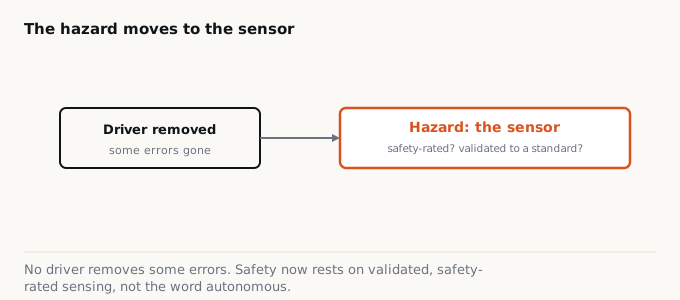
Autonomous mobile robots and automated guided vehicles change the target. Take out the driver and you take out a whole class of failures: the distracted glance, the obstructed load, the rushed shortcut, the operator who never got recertified. That is a real gain, and it is why plants are deploying these vehicles fast. But the hazard does not vanish. It moves. It moves from the driver’s behavior to the vehicle’s ability to perceive a person and stop, and to the quality of the validation behind that ability. “Autonomous” is a description of who is steering. It is not a safety rating.
The hazard moves to the sensor
Ask what actually protects a pedestrian who steps into an AMR’s path, and the answer is no longer a trained human. It is a personnel-detection system, and whether that system is any good is a question with formal, checkable answers.
Two standards frame it. ISO 3691-4 (Industrial trucks, safety requirements and verification, Part 4: driverless industrial trucks and their systems) is the international benchmark. In the United States and Canada, ANSI/ITSDF B56.5 is the primary framework, most recently updated in 2024. Both are specific in ways that matter. ISO 3691-4 requires that the truck’s personnel-detection system detect people in the intended path across the full width of the truck and its load, and that the braking system stop the truck within the operating range the detection system is specified for. In other words: the sensing and the stopping have to be matched, and verified, not assumed.
That word “safety-rated” is doing quiet, heavy lifting. A camera that helps a robot navigate is not the same as a safety-rated sensing device engineered to fail safe, so that a fault stops the vehicle rather than blinding it. In fixed robotics, OSHA leans on the same logic: its Technical Manual and long-standing guidance treat presence-sensing safeguarding devices as protective only when they are integrated to stop the hazard on intrusion and designed so that a failure deactivates the machine. A navigation sensor and a safety sensor can look identical on a spec sheet and mean entirely different things when a person walks out from behind a rack.
Mixed traffic is the hard case
The neat demonstrations happen in clear aisles. The injuries happen where humans and vehicles share space: blind corners, dock doors, congested pick faces, a pallet left half in the lane. OSHA has no robot-specific standard and regulates these deployments through the General Duty Clause, which means the burden is on you to show the hazard is controlled. The consensus standards, ISO 3691-4, ANSI B56.5, and the newer ANSI/RIA R15.08 series for industrial mobile robots, are how you demonstrate it, because they govern the commissioning of the vehicle into its actual environment, not just its behavior on a test track.
The distinction the R15.08 work draws is worth internalizing: an AGV follows predefined paths and avoids collisions along them, while an AMR navigates freely, detecting obstacles as it goes. Free navigation is powerful and it widens the set of situations the sensing has to handle correctly. More autonomy is more capability and more surface area for a detection gap.
Before you invest
Do not accept "it's autonomous" as a safety answer. Ask for the commissioning documentation and get specific: which standard was this vehicle validated to (ISO 3691-4 or ANSI/ITSDF B56.5), and is the personnel-detection system safety-rated to stop the vehicle within its braking distance across the full width of the truck and its load? If the answer names a navigation sensor rather than a safety-rated one, or cites no standard at all, you have a demo, not a safeguarded deployment.
What to watch
The encouraging trend is that the standards are catching up to the technology. ANSI/RIA R15.08 now treats industrial mobile robots as their own category, splitting requirements across the robot, the system integrator, and eventually the end user, which mirrors how the hazard is actually distributed. The plants that stay safe will be the ones that treat autonomy as a design claim to be verified, insist on safety-rated sensing, commission every vehicle against a named standard, and engineer the shared spaces, separation, sightlines, floor markings, so the sensor is a last line of defense and not the only one.
Removing the driver was supposed to remove human error. It removed one kind and handed you another: the error of assuming the machine can see you. Make it prove that it can.