"AI-powered" PPE detection, read literally
Camera systems verify one thing, that a piece of equipment is visible in frame. That's the bottom of the hierarchy of controls, dressed up as safety intelligence.
Computer-vision systems that flag a missing hard hat or safety glasses are an easy sell: the camera sees a violation, logs it, and the dashboard fills with compliance data. Read literally, though, the system verifies exactly one thing, whether a piece of equipment is visible in frame. It infers nothing about whether that equipment is worn correctly, rated for the hazard, or even relevant to the task in front of the worker.
Where PPE actually sits
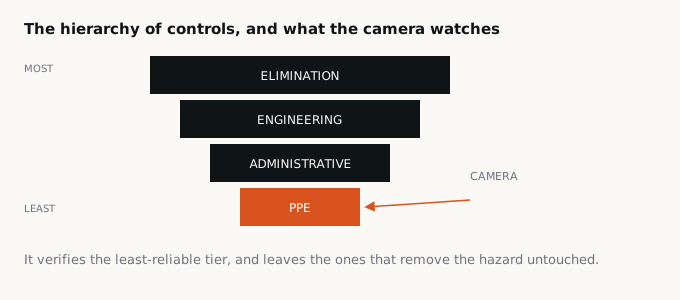
That distinction matters because PPE is the last line of defence, not the first. The NIOSH hierarchy of controls, echoed in ANSI/ASSP Z10, ranks controls by reliability: elimination and substitution at the top, then engineering controls, then administrative controls, and PPE at the very bottom, because it depends entirely on human behaviour and does nothing about the hazard itself.
A tool that maximises PPE-detection counts optimises the weakest tier while leaving the stronger ones untouched. It can make a site look safer, more green checks, fewer flagged frames, while the elimination and engineering work that would actually remove the hazard never gets budgeted, because the dashboard says compliance is at 98%.
The camera sees a category, the standard specifies a rating
This is the gap that does the real damage, and it is not a limitation of any particular vendor’s model. It is structural.
A detector is trained to answer a categorical question: is there a hard hat, yes or no. The standards that govern head protection do not work in categories. ANSI/ISEA Z89.1 separates helmets by impact type, Type I for crown impact only and Type II for crown and lateral impact, and by electrical class, with Class E rated to 20,000 volts, Class G to 2,200 volts, and Class C offering no electrical protection at all. Those are wildly different pieces of equipment for wildly different hazards. From four metres away, through a fisheye lens, they are the same yellow shape.
The same holds everywhere you look. Eye protection under ANSI/ISEA Z87.1 carries markings for impact rating, splash, and optical radiation, none of which survive image compression. Respirators sit under 29 CFR 1910.134, which requires a fit test for every tight-fitting facepiece; a camera can confirm a mask is on a face and can tell you nothing about whether that face was ever fit tested, or whether the seal is broken by two days of stubble.
So the honest output is narrower than the label suggests. Not “PPE compliance at 98%,” but “an object resembling PPE was visible in 98% of sampled frames.” Those are not the same claim, and only one of them is defensible in an incident investigation.
What the frame cannot contain
Two further things sit outside the camera’s reach, and both are the parts that matter.
The first is the hazard assessment. 29 CFR 1910.132(d) puts the obligation on the employer to assess the workplace, determine whether hazards are present, and select PPE that matches them. Detection runs downstream of that assessment and assumes it was done correctly. If the assessment specified the wrong glove for the chemical, every frame will read as compliant while the exposure continues.
The second is the task. The system does not know whether the worker is walking to the canteen or reaching into an energised panel. It applies one rule to a frame regardless of what is actually happening in it, which produces two failures at once: nuisance flags where the PPE was never required, and silence during the ten seconds that genuinely mattered. Enough nuisance flags and the response degrades in the familiar way, with the alerts triaged by whoever has time rather than by risk.
The literal-reading test
For each thing the system claims to "detect," finish this sentence: this proves that ___. "A hard hat is visible" is not "the head hazard is controlled." When you write out the honest proof statements, you'll see exactly how much of your safety case is resting on the lowest, least reliable tier of control.
Where it earns its place
None of this makes PPE detection useless, verifying the last line of defence has a place. It makes it narrow. Sold as the top of your safety stack, it quietly inverts the hierarchy: the most-watched control is the one that matters least.
Used honestly, it is a sampling instrument. It can tell you that a particular doorway, shift, or contractor crew shows a pattern worth walking down in person, which is a reasonable thing to learn from a camera. What it cannot do is close the loop, because the finding it produces always terminates in a conversation with a person rather than a change to the plant.
The test for whether a deployment is honest is the budget line underneath it. If PPE-detection spend arrives alongside continued investment in guarding, isolation, and layout, it is a monitoring tool doing a monitoring job. If it arrives instead of them, and the compliance percentage is what gets reported upward, the hierarchy has been inverted and the number on the dashboard is measuring the distance from the thing that will actually hurt someone.