Fall Clearance: The Number Nobody Posted at the Anchor
A fall arrest system can pass every inspection and still fail the worker, because the tag proves the gear, not the arithmetic of free fall plus stopping distance against the space below.
Most fall protection audits ask about the harness. Is it tagged, is it in date, is the webbing sound. Those are fair questions about the equipment. They say nothing about whether the equipment will stop a body before it reaches the floor, the conveyor, or the machine below.
That is a separate calculation. In most programs nobody is assigned to do it, and nothing in the inspection paperwork shows it was done.
What the rule actually limits
Take US federal OSHA general industry, 29 CFR 1910.140. Paragraph (d)(1) says a personal fall arrest system must limit the maximum arresting force on the employee to 1,800 pounds, and bring the employee to a complete stop with a maximum deceleration distance of 3.5 feet. Paragraph (d)(2)(ii) says the system must be rigged so the employee cannot free fall more than 6 feet or contact a lower level. Paragraph (c)(13) sets the anchorage test: at least 5,000 pounds per attached employee, or a design under a qualified person that keeps a safety factor of at least two.
The construction counterparts sit in 29 CFR 1926.502(d) and carry the same 1,800 pound, 6 foot and 3.5 foot figures (verified through a mirror of the CFR text, not the agency page, which would not load for me).
Read the free fall clause again. “Or contact a lower level” is a clearance requirement written into the rule. It is also the only clause on the list that no tag, certificate, or pull test can satisfy. It depends on where the anchor is and what is underneath.
The arithmetic the tag cannot do
OSHA’s Technical Manual, Section V, Chapter 4, lays out total fall clearance as a sum of parts: free fall distance, deceleration distance, D-ring shift (the harness riding up the body under load), the height from the back D-ring to the worker’s feet, and a safety factor. The manual treats D-ring shift as roughly 1 foot and the safety factor as roughly 2 feet. It treats the D-ring to foot distance as roughly 5 feet for a 6 foot worker. I read those as typical planning values, and the manual’s text is a construction chapter. Treat the numbers as a starting point, then replace them with the figures in your equipment’s instructions.
The non-mandatory guidelines in Appendix C to 29 CFR 1926 Subpart M say the same thing in plainer terms. Section II(l) states that sufficient distance to allow for deceleration and elongation must be maintained between the worker and any obstruction below. Section II(m) asks for tie-offs that minimize exaggerated swinging.
The general industry counterpart, Appendix C to Subpart I of Part 1910, did not load for me, so I am not quoting it.
A worked example (illustrative numbers)
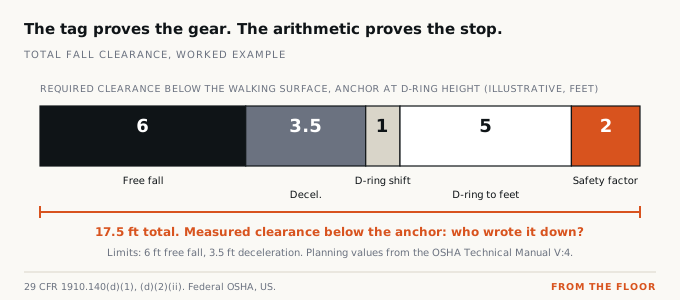
Every figure below is an assumption I chose, built from the limits above. None comes from a manufacturer. The worked inputs are a 6 foot lanyard, a 3.5 foot deceleration distance (the legal maximum, used here as a conservative stand-in), 1 foot of D-ring shift, 5 feet from D-ring to feet, and a 2 foot safety factor. Required clearance is measured from the walking surface.
Anchor at D-ring height: free fall is 6 feet. Total is 6 + 3.5 + 1 + 5 + 2 = 17.5 feet.
Anchor 2 feet above the D-ring: free fall drops to 4 feet. Total is 15.5 feet.
Anchor at foot level: free fall is 6 + 5 = 11 feet. Total is 22.5 feet, and the setup already breaks the 6 foot limit before clearance matters.
The pattern is simple. The lower the anchor, the more room the fall needs. Many sites do the opposite by default: they tie off at the nearest available steel, which is often low.
Why the inspection misses it
A harness inspection is a condition check on an object. It asks whether the gear can do its job. The clearance question asks whether the job, as rigged at this location, fits the space. Different question, different evidence.
There is also a human reason. The calculation depends on the anchor, the lanyard or device, the worker’s height, and the structure below. No single person owns all four. The equipment owner checks gear. The area owner knows the floor. The result is a number nobody posted.
Suspension is the second half of the same failure. Appendix C asks that employees can be promptly rescued or rescue themselves, and notes the suspended worker may not reach a work level alone. The Technical Manual says reduced blood flow from harness straps can cause loss of consciousness within minutes. A system that stops the fall with 6 inches to spare still needs a rescue plan. I could not verify a specific NIOSH or FACE fatality count tied to clearance failure, so I make no claim about frequency here.
What works
Post the number at the anchor, not in the binder. A required clearance figure on a tag or sign at each designated tie-off turns the check into something a worker can do in seconds. Fall restraint, which stops the worker reaching the edge at all, is the answer wherever the number cannot be met. (Under the hierarchy of controls, restraint is also the better choice where it is feasible.)
The diagnostic
This week, pick five tie-off locations that workers actually use. For each, record the anchor height relative to the D-ring, the lanyard or device length, and the measured clearance from the walking surface to the first obstruction below. Add up free fall, deceleration distance from the equipment instructions, D-ring shift, D-ring to feet, and a safety margin, then compare. Mark any location where required exceeds measured as a fail, and any where free fall exceeds 6 feet as a fail regardless of clearance. Check horizontal offset from the anchor too, since a distant anchor adds swing. In an illustrative set: anchor at 7 feet, required 15.5, measured 22, pass; anchor at 5 feet, required 17.5, measured 16, fail; anchor at floor level, free fall 11 feet, fail; anchor at 8 feet, required 14.5, measured 14, fail; anchor at 6 feet, required 16.5, measured 17, pass, but 10 feet off to one side, so review for swing. For the tie-off points on your floor today, who has written down the required clearance next to the measured clearance, and where is it posted?